Tuesday, January 17, 2012

Jack Morris is going to be a Hall of Famer, and that's OK.

By Bill


I've been about as critical of Jack Morris -- or, more accurately, of his Hall of Fame case -- as anyone traversing this here information superhighway ever has been. I'm not ashamed. One post in particular was probably one of my two or three favorites among all the baseball things I've ever written, comparing Bert Blyleven to Morris + Mariano Rivera.

But that's enough, now. More than enough. By now, every single person in a position to care -- and that includes every single BBWAA voter, or close enough to it -- has heard all the arguments. They know he wasn't really the best pitcher of the 1980s, that his career stats don't stand out in any meaningful way from those of Frank Tanana or Dennis Martinez, that his ERA was only a touch better than average, and would be the highest of any pitcher in the Hall. They even know -- or have heard, at least, if they won't allow themselves to be convinced -- that he didn't actually "pitch to the score." There's nothing new under the Jack Morris world's intense angry red mustachioed sun.

Oh, there might be new ways to say things to keep it interesting and worth saying -- I'd humbly suggest that the post above might have qualified, and this one last week, by BPro's Jonathan Bernhardt, certainly did -- and every now and then you might just need to lash out against something that's obviously, objectively wrong and happens to be about Morris ... but just spitting out stats and comps and telling people he's not qualified, whether on Twitter or your blog or anywhere else, doesn't cut it anymore. It's browbeating, and it's counterproductive at this point.

Here's the thing: he's going in. There's absolutely nothing you, or I, or all of us together can do about that. And that's okay.

Transparency in Hall of Fame Voting


By Mark Smith

I think there was a “groupthink” Hall of Fame ballot among “sabermetricians”. It involved voting for Tim Raines, Jeff Bagwell, Barry Larkin, and Alan Trammel, but it was perfectly fine to add Edgar Martinez, Mark McGwire, Rafael Palmeiro, and/or Larry Walker. If you are a “big Hall” guy, you were allowed to bring in Fred McGriff and/or Dale Murphy, but those ten are about where the line was drawn. I say “groupthink” because anyone outside of those 10 were routinely criticized and even McGriff or Murphy would have brought you a decent amount of criticism and at least a demand for a good reason. The quotation marks were added because I think those 8-10 players were the result of solid research and comparison, but it was so common to see the names that it was almost expected. The voting surrounding the actual voters, however, was much more scattered.

Because of the variance in the voting among the electorate this year and in past years, there have been calls for an end to the secret ballot. The idea is pretty simple. The BBWAA is voting on a fairly important part of the game, and because the votes seem scattered and in no way consistent, fans want the votes revealed in order to make sure the voters are doing enough research and using consistency in their thinking. It’s a call for accountability.

The whole thing seems akin to Congress. Congress votes on legislation that will affect the future of the country, and because of the importance of the voting and to avoid corruption (haha), the voting is open to the public record. The lack of a secret ballot helps voters know who they should vote in to office and who actually reflects the district’s beliefs. The problem is that the type of voting isn’t exactly similar. Congress is making country-altering decisions. BBWAA voters aren’t even making baseball-altering decisions (it doesn’t really matter to baseball itself who is voted in and not). Perhaps if the BBWAA voted on instant replay or the like, they should be held accountable, but their votes are more akin to the Congress being asked to vote on the best politicians in American history for a private museum. We need the Congressional Record to be open. We want the Hall of Fame ballot to be open.

As a result of the lack of actual need, the revelation of ballots needs to be negotiated, either formally or informally. In order to get the voters to reveal the ballots, you have to give the writers something in return. Why? Let’s pretend to be in the BBWAA for a moment. Why would you reveal your vote? One answer could be the attention, but the one we’re focused on is accountability. You want your readers to know you are accountable, responsible, for your vote. I hate to break it to you, but that isn’t exactly a great motivating factor. Quite a few voters may feel the need to be accountable, but for the most part, accountability doesn’t pay the bills or keep their HoF vote. It’s theirs for life, so you’re going to have to work harder. The best result is garnering praise, but the most likely result is having to constantly defend your vote to smart and uninformed arguers alike. When the most likely result of your revelation is basically being annoyed and probably still having your intelligence questioned, I'm not surprised that most of the writers don't reveal their votes (though I'd like to note that I don't think the writers who did not reveal their votes are afraid of accountability; there are other reasons they may not have written something to that effect).

To be honest, the strategy isn’t to add something (you could try money or something, but I doubt that would work) but to subtract something - your attention and readership. I don’t see that happening, however, so we’re back to square one. We’re caught. We’re unhappy with the way things are (it should be noted that I would like writers to reveal and defend their votes; I agree theoretically), but we don’t really have any leverage to change the situation. The situation is more like players using steroids. They finally agreed to testing, but that was only because they believed that the credibility of their profession was on the precipice of collapse. I don’t think that mainstream journalism’s credibility is in the same jeopardy.

Listen, I would love for writers to be held accountable for their votes. It’s the best way to get them to vote in an educated and responsible manner. But we’re caught. The BBWAA and Hall of Fame rules don’t force them to reveal their votes, and there’s no compelling reason to make them change.

Thursday, January 12, 2012

30 teams, 30 reasons to hate

by Jason Wojciechowski
Following up on my last post, here is one thing for each team (almost each team) that I hold against that team's fans. I hate all of you.
Yankees -- Jeffrey Maier. I don't care how long ago it was. Jeffrey Maier
Red Sox -- pink hats, dogg. Pink hats.
Rays -- your very existence confounds me. If you're a Floridian who was desperate for a baseball team of your own, how did you not end up with the Marlins? I mean, be a fan of who you want, I don't care. I just don't get it.

Happy Birthday...

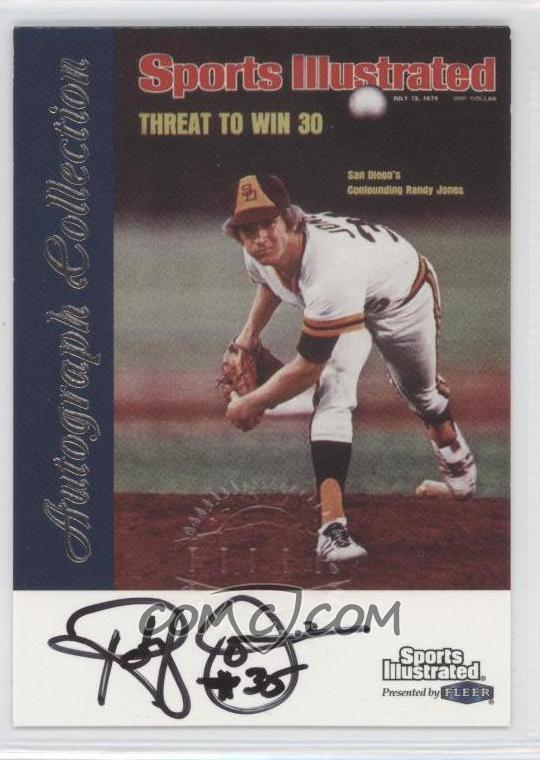
Randy Jones!

The National League gave out ten Cy Young Awards in the decade of the 1970s, as you'd probably expect. Eight of them went to players who were now in the Hall of Fame: two to Tom Seaver, two to Steve Carlton, and one each to Bob Gibson, Fergie Jenkins, Gaylord Perry, and Bruce Sutter.

One of the other two was Mike Marshall, the rubber-armed reliever turned kind of crazy kinesiologist doing scary things with young pitchers' arms, who appeared in a record 106 games in relief in 1974 -- 13 in a row, at one point -- and pitched 208.1 innings, all in relief, gathering 15 wins (with 12 losses) and a league-leading 21 saves.

The tenth one, you've probably guessed, was Randy Jones.

Wednesday, January 11, 2012

Peter Abraham Is Not a Plagiarist, But He Is An Insufferable Douchebag

By The Common Man

Douchebag
One last navel-gazing post this week, before we get back to business here on The Platoon Advantage. Some of you have asked who the writer is who, through his threats and general complaints, got us removed from the SweetSpot Network, despite the fact that seemingly everyone (including several writers at ESPN) thought our Bagwell and “plagiarism” series was excellent.  As Bill said earlier, we don't want to personally attack writers for their baseball opinions.  But when a writer reveals himself to be a jackass through his words and actions, we feel somewhat differently about the whole thing.

So, at the urging of at least one national writer, who referred to our culprit as “a complete asshole” and revealed that “even people who work with him/by him…loathe him,” we’re happy to announce that, when you see us all driving shiny new Camaros over the next few months (our swift departure from ESPN has revealed a great deal of interest in our services and our blog, as it turns out), you have The Boston Globe’s Peter Abraham to thank for it.

One quick thought on SaberBoy

By Bill

I was going to make a whole "manifesto" out of this: the key principles of SaberBoy's view on the baseball world. But I wasn't making it funny enough to come off as intended, and I don't take myself nearly seriously enough to do it straight. So I'll just stick to the one most important point.

By now, if you're reading this, odds are you've already gotten a glimpse (at least) of the whole "SaberBoy" thing. If not, the internet has you covered: it's wrapped up pretty well by Stuart Jones here, by Steve Gardner of USA Today here, and by Craig Calcaterra at NBC Sports here, and our very own Mark has a profile of the new hero right here. Sarah Wiener designed the logo to the right, and has T-shirts and other stuff for sale. Craziness, all of it. Certainly not what I was expecting to come out of a Monday that started with us announcing our departure from ESPN. In the span of 24 hours, thanks pretty much entirely to the new name and avatar, I picked up something over 250 new Twitter followers. That was a lot of fun.


There's a pretty obvious danger in a superhero character named SaberBoy, though, and I think it's fairly well outlined (as I read it, at least) in a comment by one of my favorite tweeters and casual baseball-related acquaintances:


Indeed, most of the torrent of initial jokes centered around the new superhero making the world safe for [tired statgeek cliches] against his arch-nemeses [traditional mainstream sportswriter] and [Jack Morris or Jim Rice or Tim McCarver]. Lots of the lines were really funny. Mark had a few right here. There's a line in my Twitter bio that gives a similar impression -- a crusader to battle the BBWAA and bring them into line.


But that's not what it was about, though. In fact, I think it's kind of the opposite of what it's about.

Tuesday, January 10, 2012

Leave other fans aloooooooooooone

by Jason Wojciechowski

As a blogger and inveterate Tweeter, I don't have a lot of moral authority to ask people not to make fun of something. We've all jabbed beat writers, said mean things about front offices, wished that TV announcers would lose their jobs (or even rejoiced when the latter actually happens). There is an area that I think we'd all be better off leaving alone, though: fans.

Asshole fans exist everywhere. Nice, sober guys don't get into fights in the stands at the game. Dicks and drunks do. Chill bros don't run on the field so they'll get tased. Attention whores living unfulfilled lives do. Committed fans don't jabber on their cell phones through the whole game, pausing only long enough to wave at a TV camera when it points their way. People with misplaced priorities do. (What on earth could be more important than the game on the field?)