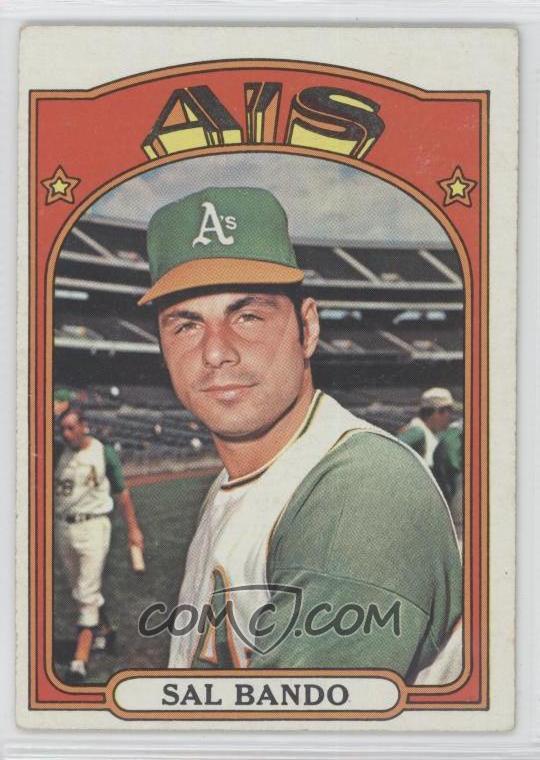
Sal Bando!
As a birthdate, February 13 suffers from a shortage of great players -- Bando's 242 career homers are more than four times as many as #2, and no pitcher amassed 50 wins or 500 strikeouts -- and is largely devoid of current players, so it's not likely to get better any time soon.
What it's not missing, though, is interesting stories. Tragic figure Donnie Moore would have turned 58 today; villainous figure (and just plain terrible baseball player who nonetheless got to play for 15 years) Hal Chase was spawned 129 years ago on this date.
If you've read this, though, you know I have to pick Bando to talk about today, who, along with a slew of more or less equally excellent third basemen, is one of the most underrated players in baseball history. Bando woke up this morning as a brand new sixty-eight year old.
Showing posts with label third base. Show all posts
Monday, February 13, 2012
Happy Birthday...
Labels:
baseball,
birthday,
Sal Bando,
third base
Tuesday, November 8, 2011
Spare a thought for the poor, neglected third baseman
By Bill
One of Bill James' books -- I think it was one of the Historical Baseball Abstracts, but I'm not positive -- talks about a sudden shift in the way baseball people perceived the third base position. In the game's early-ish days, third base was looked at as a defense-first position, a lot more like second base is now -- and if anything, second was the more offense-minded position of the two.
James (or one of his assistants; something tells me it was Jim Baker) credited the eventual perception shift on the little-remembered Harlond Clift, a star of the terrible Browns teams of the 1930s and 1940s. Clift's offensive numbers don't look like much today, but he really was the first power-hitting third baseman. Two 3Bs between the beginning of time and 1940 hit more than thirty homers in a season: one was Mel Ott, only barely a third baseman (and for only that one season), and the other was Clift. There were ten seasons by third basemen in that span where even twenty homers were hit: one was Ott; one was Ned Williamson, who took advantage of a rule change and a ridiculous ballpark to hit a record 27 of them in 1884; and four of the remaining eight were by Clift. And Clift, in his twenties, was a complete hitter, keeping his average near .300 and drawing plenty of walks. Clift really was a relevation; you can look back through history from now and see Alex Rodriguez and Mike Schmidt and George Brett and Eddie Mathews and Chipper Jones and Evan Longoria, and Clift doesn't look like much. Looking back from 1940, though, there was pretty much only Clift. So then came Mathews et al., and Clift had kicked off this big change in the way people looked at the position; it was another second base, and suddenly became another first base. Post-Clift, your third baseman was supposed to be one of the anchors of your offense.
Here's the punchline, though: I think that shift in the way third base was perceived was wrong. Or, at least, much, much too drastic.
One of Bill James' books -- I think it was one of the Historical Baseball Abstracts, but I'm not positive -- talks about a sudden shift in the way baseball people perceived the third base position. In the game's early-ish days, third base was looked at as a defense-first position, a lot more like second base is now -- and if anything, second was the more offense-minded position of the two.
James (or one of his assistants; something tells me it was Jim Baker) credited the eventual perception shift on the little-remembered Harlond Clift, a star of the terrible Browns teams of the 1930s and 1940s. Clift's offensive numbers don't look like much today, but he really was the first power-hitting third baseman. Two 3Bs between the beginning of time and 1940 hit more than thirty homers in a season: one was Mel Ott, only barely a third baseman (and for only that one season), and the other was Clift. There were ten seasons by third basemen in that span where even twenty homers were hit: one was Ott; one was Ned Williamson, who took advantage of a rule change and a ridiculous ballpark to hit a record 27 of them in 1884; and four of the remaining eight were by Clift. And Clift, in his twenties, was a complete hitter, keeping his average near .300 and drawing plenty of walks. Clift really was a relevation; you can look back through history from now and see Alex Rodriguez and Mike Schmidt and George Brett and Eddie Mathews and Chipper Jones and Evan Longoria, and Clift doesn't look like much. Looking back from 1940, though, there was pretty much only Clift. So then came Mathews et al., and Clift had kicked off this big change in the way people looked at the position; it was another second base, and suddenly became another first base. Post-Clift, your third baseman was supposed to be one of the anchors of your offense.
Here's the punchline, though: I think that shift in the way third base was perceived was wrong. Or, at least, much, much too drastic.
Labels:
baseball,
Ron Santo,
third base
Subscribe to:
Posts (Atom)

