Here we are again. Four weeks into our real-time trip back through the fantastic season of 2001. That thing I was using to take images of my tweets has completely stopped working, so without further ado:
Monday, April 23: Only three games were played. Mondays (and Thursdays) have been the light days for quite a while now, but it feels like a long time since any regular season day was quite this light. Nonetheless, Randy Johnson had a particularly awesome day, throwing a complete-game shutout (6 hits, 0 walks, 10 strikeouts) as the Diamondbacks beat the Marlins 6-0.
Friday, April 29, 2011
Thursday, April 28, 2011
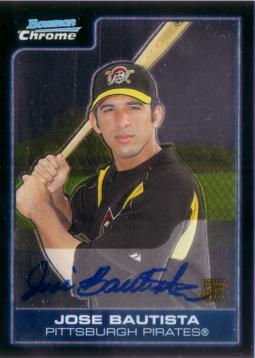
Re-Projecting Jose Bautista
By Bill
"Re-projecting" is something I would occasionally do early in the season at my old blog (at least in 2009; I don't remember whether I did it again in 2010). The basic idea is this: we know, or should know, that no matter how convincing a player's performance is after 18 or 20 or 30 games, his performance over the last several years -- adjusted for age, park, etc., as the various projection systems do -- tell us a lot more than these first few weeks do about how he's likely to perform over the next 120-plus games.
But the other thing about these early games, of course, is that they still count. Any given player is likely to match his projection from here on out, but these first few weeks still happened, and will impact his overall numbers. So what I did, and what I'm going to do again with one player right now, is look at one player with a particularly surprising start to the season, apply the projections to the rest of the season, and take a look at where his end-of-the-year numbers might end up.
The system I'm going to continue using is PECOTA -- not because I think it's better than the rest, but because I think they're all pretty fungible, and Baseball Prospectus puts nice descriptive words alongside their numbers (and, now, because I know and like a bunch of these BPro guys).
And the player is Jose Bautista.
"Re-projecting" is something I would occasionally do early in the season at my old blog (at least in 2009; I don't remember whether I did it again in 2010). The basic idea is this: we know, or should know, that no matter how convincing a player's performance is after 18 or 20 or 30 games, his performance over the last several years -- adjusted for age, park, etc., as the various projection systems do -- tell us a lot more than these first few weeks do about how he's likely to perform over the next 120-plus games.
But the other thing about these early games, of course, is that they still count. Any given player is likely to match his projection from here on out, but these first few weeks still happened, and will impact his overall numbers. So what I did, and what I'm going to do again with one player right now, is look at one player with a particularly surprising start to the season, apply the projections to the rest of the season, and take a look at where his end-of-the-year numbers might end up.
The system I'm going to continue using is PECOTA -- not because I think it's better than the rest, but because I think they're all pretty fungible, and Baseball Prospectus puts nice descriptive words alongside their numbers (and, now, because I know and like a bunch of these BPro guys).
And the player is Jose Bautista.
Labels:
baseball,
Jose Bautista,
Toronto Blue Jays
SweetSpot Roundup 4/28
In today's roundup, Mariano Rivera has been too good for too long, Ethier's too hot to get out, Wilson Ramos is making the Twins look bad, and managing a bullpen is too complicated for Ned Yost.
Labels:
baseball,
SweetSpot Roundup
Wednesday, April 27, 2011
The Revenge of Glenn Davis
By The Common Man
Glenn Davis was a power-hitting first baseman, who starred for the Houston Astros in the late 1980s. In 1990, he suffered a strained ribcage and had a down year. He still wanted a multi-year extension, and Houston wouldn’t give it to him, given that they had Jeff Bagwell waiting in the wings. So they dealt him to Baltimore in what became one of the worst trades of all time. Because of a bad back, the Orioles got exactly 185 games out of Davis over three seasons, in which he hit .259/.332/.467, while paying him $10.5 million. That kind of production would still be a bust today.
The Astros, meanwhile, received Curt Schilling, Steve Finley, and Pete Harnisch in the deal, who would have 120.4 WAR between them ove the rest of their careers, to Davis’ 0.1 WAR.
Not that the Astros got much of that benefit, mind you. They only got 22.2 WAR from the trio and, frankly, got nothing for either Curt Schilling or Pete Harnisch. That said, the legacy of the Davis deal still remains in the Astros system. Consider Davis’ very incestuous family tree, which was so complicated it needed to be color-coded (red denotes the end of a line because a player was either released, waived, or became a free agent and there was no compensation):
This went so well the first time around that The Common Man decided to try it again.
Glenn Davis was a power-hitting first baseman, who starred for the Houston Astros in the late 1980s. In 1990, he suffered a strained ribcage and had a down year. He still wanted a multi-year extension, and Houston wouldn’t give it to him, given that they had Jeff Bagwell waiting in the wings. So they dealt him to Baltimore in what became one of the worst trades of all time. Because of a bad back, the Orioles got exactly 185 games out of Davis over three seasons, in which he hit .259/.332/.467, while paying him $10.5 million. That kind of production would still be a bust today.
The Astros, meanwhile, received Curt Schilling, Steve Finley, and Pete Harnisch in the deal, who would have 120.4 WAR between them ove the rest of their careers, to Davis’ 0.1 WAR.
Not that the Astros got much of that benefit, mind you. They only got 22.2 WAR from the trio and, frankly, got nothing for either Curt Schilling or Pete Harnisch. That said, the legacy of the Davis deal still remains in the Astros system. Consider Davis’ very incestuous family tree, which was so complicated it needed to be color-coded (red denotes the end of a line because a player was either released, waived, or became a free agent and there was no compensation):
Labels:
baseball,
Glenn Davis,
Houston Astros,
Tommy Manzella,
trade tree
How Chuck Knoblauch continues to affect your daily life...
By The Common Man
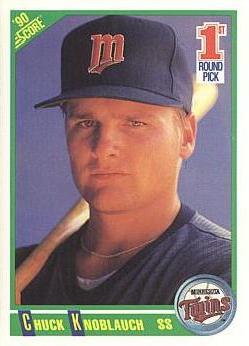
The Common Man has forever been fascinated with Chuck Knoblauch, so when Craig Calcaterra asked readers to identify the most hated player in each team’s history, TCM immediately went to Knobby as his default answer. Knoblauch came up for the Twins in 1991, finally providing the Twins with solidity at the position for the first time since 1985. He won the Rookie of the Year Award, and even excelled in the postseason, hitting .326 with 8 runs scored. Knoblauch would quickly become a fan favorite for his small stature, obvious hustle, and his excellent play. He was essentially David Eckstein’s much, much better older brother.
The Twins rewarded an incredible 15.3 WAR run from 1995-1996 with a five year contract extension for around $30 million, making him one of the highest paid players in the game. But before the end of August of 1997, less than a season into the new deal, Knoblauch expressed his frustration with the Twins and “requested” to be traded to another club, with the Yankees on the top of his wish list. There was a competing offer from the Indians that reportedly would have netted the Twins Chad Ogea, Steve Karsay, and Enrique Wilson, but thankfully the Twins didn’t bite. Instead, Knoblauch got his wish and was shipped to the Bombers for Eric Milton, Christian Guzman, Brian Buchanan, and $3 million.
Twins fans, naturally, didn’t take Knoblauch’s departure well, booing him lustily whenever the Yankees came to town, and showering him with batteries and other trash when he tried to play leftfield in 2001. It’s likely there is no more hated figure in Twins history.
But here’s the thing, the Knoblauch trade was ridiculously good for the Twins, and the club continues to see benefits today. Check out Chuck Knoblauch’s family tree:
The Common Man has forever been fascinated with Chuck Knoblauch, so when Craig Calcaterra asked readers to identify the most hated player in each team’s history, TCM immediately went to Knobby as his default answer. Knoblauch came up for the Twins in 1991, finally providing the Twins with solidity at the position for the first time since 1985. He won the Rookie of the Year Award, and even excelled in the postseason, hitting .326 with 8 runs scored. Knoblauch would quickly become a fan favorite for his small stature, obvious hustle, and his excellent play. He was essentially David Eckstein’s much, much better older brother.
The Twins rewarded an incredible 15.3 WAR run from 1995-1996 with a five year contract extension for around $30 million, making him one of the highest paid players in the game. But before the end of August of 1997, less than a season into the new deal, Knoblauch expressed his frustration with the Twins and “requested” to be traded to another club, with the Yankees on the top of his wish list. There was a competing offer from the Indians that reportedly would have netted the Twins Chad Ogea, Steve Karsay, and Enrique Wilson, but thankfully the Twins didn’t bite. Instead, Knoblauch got his wish and was shipped to the Bombers for Eric Milton, Christian Guzman, Brian Buchanan, and $3 million.
Twins fans, naturally, didn’t take Knoblauch’s departure well, booing him lustily whenever the Yankees came to town, and showering him with batteries and other trash when he tried to play leftfield in 2001. It’s likely there is no more hated figure in Twins history.
But here’s the thing, the Knoblauch trade was ridiculously good for the Twins, and the club continues to see benefits today. Check out Chuck Knoblauch’s family tree:
Labels:
baseball,
Chuck Knoblauch,
Minnesota Twins,
trade tree
SweetSpot Roundup 4/27
In today's roundup, Randy Wolf takes a step forward and Colby Lewis takes a step back. Derek Jeter hangs A-Rod out to dry while Rick Ankiel has no one to blame but himself. And coffee is for closers (so the Phillies don't get any).
Labels:
baseball,
SweetSpot Roundup
Tuesday, April 26, 2011
How I Learned to Stop Worrying and Love the "Mallpark"
By The Common Man
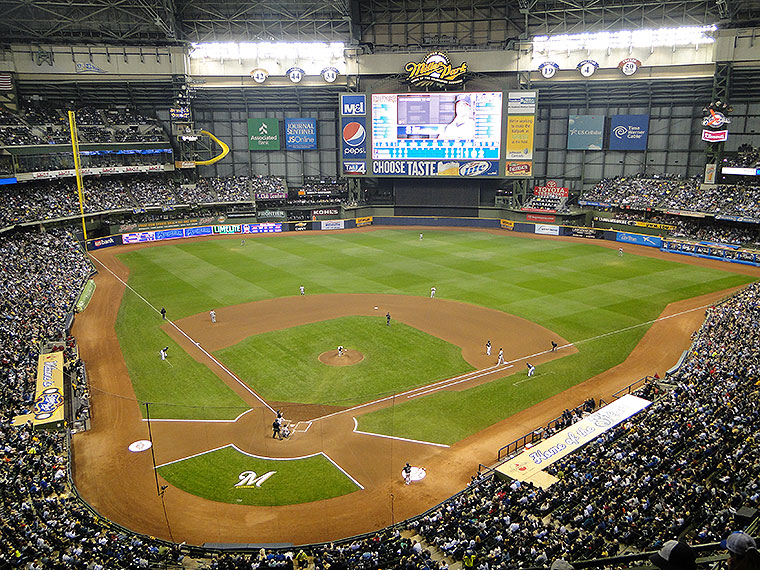
This weekend, The Common Man was lucky enough to take in two ballgames in person, traveling down to Wrigley Field to catch a game with his blog-mate/heterosexual life-partner Bill on Friday and heading over to Milwaukee with The Boy to see the Brewers play with our good friend, and unofficial mayor of Milwaukee, Larry Granillo of Baseball Prospectus, who scored us some tickets.
To be honest, TCM has never really enjoyed the “Mallpark” experience provided by the newer stadiums, such as Miller Park. Too many bells, too many whistles. Fireworks, retractable roofs, sushi rolls, mascot slides, t-shirt cannons, random games and attractions. So much to distract you from the action on the field. It’s often more like a carnival than a baseball game. So while TCM appreciates the warmth and comfort available in most modern parks, he also has traditionally been a curmudgeon about them.
![]() |
| Miller Park |
To be honest, TCM has never really enjoyed the “Mallpark” experience provided by the newer stadiums, such as Miller Park. Too many bells, too many whistles. Fireworks, retractable roofs, sushi rolls, mascot slides, t-shirt cannons, random games and attractions. So much to distract you from the action on the field. It’s often more like a carnival than a baseball game. So while TCM appreciates the warmth and comfort available in most modern parks, he also has traditionally been a curmudgeon about them.
Labels:
ballparks,
baseball,
Mallparks,
Miller Park,
Wrigley Field
Subscribe to:
Posts (Atom)