By Bill
So I hope you're aware by now of the High Heat Stats blog, which is basically what the Baseball Reference blog used to be, but is no longer hosted at BB-Ref.
They've done a fun couple posts lately, attempting to list the 50 most overrated and then most underrated hitters in baseball history (today, they're starting on the pitchers). Being specifically a stats blog, of course, they were pretty limited in the ways they could come up with to arrive at lists like that. I think the one they devised (with the help of the excellent Sky Kalkman) was pretty brilliant.
Basically: use the player's career rWAR as a proxy for his true worth/value/talent/etc. Then take BB-Ref's EloRater -- a system which gauges where the thousands of BB-Ref users rate each player -- as a measure of how the fans view the player. Then, figure out an expected WAR (eWAR), representing the career rWAR we'd assume a player would have if his production merited the rating he gets on the EloRater, based on the players surrounding him in the EloRater rankings. So, the players with the highest eWAR-rWAR are your most overrated players, and the ones with the highest rWAR-eWAR are your underrateds.
Ingenious...but not necessarily perfectly attuned to tell you what the headlines promise (which they happily recognize, and I'm not sure any stat or collection of stats could do that). Some of the guys who show up on the "overrated" list spent time in the Negro Leagues, or were otherwise prevented from putting up a career rWAR that accurately reflects their worth; most of the underrated list ends up being nineteenth-century guys, whose "replacement level" was likely much, much lower than the current ones. They're interesting lists, but they don't necessarily reflect the most under- and overrated players in baseball history.
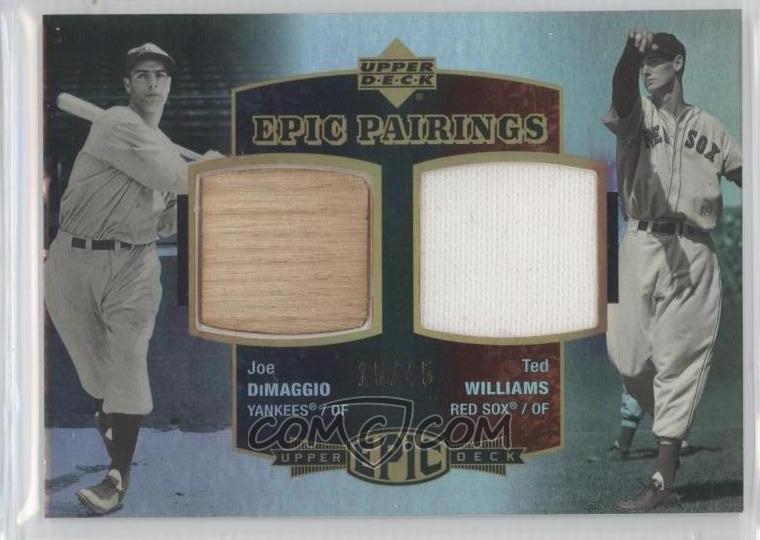
I want to focus on two names in particular, though, from the overrated list: Ted Williams and Joe DiMaggio.
Showing posts with label Ted Williams. Show all posts
Wednesday, January 25, 2012
Thursday, September 10, 2009
Random Thursday: June 11, 1960, Chicago vs. Boston
When baseball’s elder statesmen square off, doesn’t it seem like something special always happens? Fortune smiles again on The Common Man, as his browser, with eyes closed, leapt from Scott Sullivan’s page to this June 11, 1960 contest between the Chicago White Sox and Boston Red Sox. The game was the first of two that day between the Soxes, and was certainly the more memorable.
The Sox lineup featured Hall of Famers Nellie Fox (in his final decent year; raise your hand if you knew he was basically done at age 32) and Luis Aparicio, and was bolstered by Hall of Very Good members Minnie Minoso and Roy Sievers. The Sox in 1960 were a good club, in the middle of a good run. For 17 straight seasons, the Sox finished above .500 (1951-1967), though they managed just one pennant (1959, when they lost in the World Series to the Dodgers). In 1960, they finished in the 8-team American League, with an 87-67 record. They couldn’t get close to the Yankees, however, who (as usual) finished 10 games better thanks to Mantle, Maris, and Big Bill Skowron.

Minoso, Jim Landis, Aparicio, and Fox receive their Gold Gloves from 1959.
The Red Sox were on the opposite end of the spectrum. In 1960, they would finish in 7th place, losing 89 games. Poor personnel decisions, including the team’s famous refusal to pursue and sign African-American talent, had caught up with Boston, and they were unable to compensate for an aging core and bad pitching staff. The Sox’s starter that day was Ike Delock, a former swingman pressed into the rotation who would finish the year with a 4.73 ERA (84 ERA+) in 23 starts. The lineup featured Hall of Very Good hitters Pete Runnels and Vic Wertz (whose greatest historical comp is Roy Sievers, actually).
But what made the game stand out was the battle between two legends near the end of their respective careers. 40-year old Early Wynn started for Chicago, sitting on 273 career victories, a year removed from going 22-10 and winning the ML Cy Young Award (the Cy Young award was only given to one pitcher a year through 1966). Though pitching well, Gus had lost four straight in which his team had scored just seven runs behind him.
For the Red Sox, Ted Williams started and played in LF. Williams, had missed most of April and May, totaling just 27 plate appearances. But in June, Williams was on fire. In 96 PAs, The Splinter would hit 11 homeruns, bat .329/.458/.803), and drive in 24 runs. He had hit a solo homerun the day before and was just starting to round into playing shape.
Wynn allowed a leadoff homerun to Don Buddin, but settled down to retire the next 8 and keeping the Sox off the board through five. On the strength of a Gene Freese homer and a Nellie Fox double in the 2nd, the Sox scored two. Wynn himself had gone 2-2 with two singles, one of which moved Jim Landis into scoring position for Fox’s double, and the other of which drove in Freese in the 4th. At the end of the 5th, Chicago led the Red Sox 3-1. Williams had underwhelmed in two at bats, fouling out once to third base and once to catcher. In the bottom of the 5th, Wynn allowed a leadoff single to Pete Runnels to bring up The Kid. Williams hit a long fly to right field that cleared the fence for his 5th homer of the year, and 497th of his career.

Wynn got out of the 6th without allowing another run, and in the top of the 7th Delock ran into more trouble for Boston. Chicago loaded the bases on two singles and an error, bringing up Sievers, who struck out. But when Delock hit Sherm Lollar, he forced in Nellie Fox, giving the White Sox a 4-3 lead.
Wynn was removed from the game with one-out in the 7th after giving up a single to Bobby Thomson. He was relieved by Gerry Staley, the Sox’s relief ace, who escaped with no damage. Delock got into trouble in the top of the 9In the bottom of the 8th, however, Williams led off. The Kid worked out a walk and was replaced by a pinch runner. Vic Wertz hit a big opposite field home run that gave the Red Sox the 5-4 lead, which they would hold on to. Staley was hung with the loss, and Mike Fornieles, Boston’s relief ace, ended up with the win after pitching the last two frames.
Williams would have an excellent season (.316/.451/.645, 29 homers) despite getting just 390 PAs, and would, of course, retire at the end of the season after hitting a home run (#521) in his final at bat. Wynn would make the All Star team that year, and go 13-12 with a 3.49 ERA, and lead the league in shutouts. He hung on for three more years after that. Gus pitched well in the first half of 1961 before injuries forced him to the shelf for the rest of the year. He struggled in 1962, and finished with an even 300 wins as a pitcher-coach for the ’63 Indians.
The Sox lineup featured Hall of Famers Nellie Fox (in his final decent year; raise your hand if you knew he was basically done at age 32) and Luis Aparicio, and was bolstered by Hall of Very Good members Minnie Minoso and Roy Sievers. The Sox in 1960 were a good club, in the middle of a good run. For 17 straight seasons, the Sox finished above .500 (1951-1967), though they managed just one pennant (1959, when they lost in the World Series to the Dodgers). In 1960, they finished in the 8-team American League, with an 87-67 record. They couldn’t get close to the Yankees, however, who (as usual) finished 10 games better thanks to Mantle, Maris, and Big Bill Skowron.

Minoso, Jim Landis, Aparicio, and Fox receive their Gold Gloves from 1959.
The Red Sox were on the opposite end of the spectrum. In 1960, they would finish in 7th place, losing 89 games. Poor personnel decisions, including the team’s famous refusal to pursue and sign African-American talent, had caught up with Boston, and they were unable to compensate for an aging core and bad pitching staff. The Sox’s starter that day was Ike Delock, a former swingman pressed into the rotation who would finish the year with a 4.73 ERA (84 ERA+) in 23 starts. The lineup featured Hall of Very Good hitters Pete Runnels and Vic Wertz (whose greatest historical comp is Roy Sievers, actually).
But what made the game stand out was the battle between two legends near the end of their respective careers. 40-year old Early Wynn started for Chicago, sitting on 273 career victories, a year removed from going 22-10 and winning the ML Cy Young Award (the Cy Young award was only given to one pitcher a year through 1966). Though pitching well, Gus had lost four straight in which his team had scored just seven runs behind him.
For the Red Sox, Ted Williams started and played in LF. Williams, had missed most of April and May, totaling just 27 plate appearances. But in June, Williams was on fire. In 96 PAs, The Splinter would hit 11 homeruns, bat .329/.458/.803), and drive in 24 runs. He had hit a solo homerun the day before and was just starting to round into playing shape. Wynn allowed a leadoff homerun to Don Buddin, but settled down to retire the next 8 and keeping the Sox off the board through five. On the strength of a Gene Freese homer and a Nellie Fox double in the 2nd, the Sox scored two. Wynn himself had gone 2-2 with two singles, one of which moved Jim Landis into scoring position for Fox’s double, and the other of which drove in Freese in the 4th. At the end of the 5th, Chicago led the Red Sox 3-1. Williams had underwhelmed in two at bats, fouling out once to third base and once to catcher. In the bottom of the 5th, Wynn allowed a leadoff single to Pete Runnels to bring up The Kid. Williams hit a long fly to right field that cleared the fence for his 5th homer of the year, and 497th of his career.

Wynn got out of the 6th without allowing another run, and in the top of the 7th Delock ran into more trouble for Boston. Chicago loaded the bases on two singles and an error, bringing up Sievers, who struck out. But when Delock hit Sherm Lollar, he forced in Nellie Fox, giving the White Sox a 4-3 lead.
Wynn was removed from the game with one-out in the 7th after giving up a single to Bobby Thomson. He was relieved by Gerry Staley, the Sox’s relief ace, who escaped with no damage. Delock got into trouble in the top of the 9In the bottom of the 8th, however, Williams led off. The Kid worked out a walk and was replaced by a pinch runner. Vic Wertz hit a big opposite field home run that gave the Red Sox the 5-4 lead, which they would hold on to. Staley was hung with the loss, and Mike Fornieles, Boston’s relief ace, ended up with the win after pitching the last two frames.
Williams would have an excellent season (.316/.451/.645, 29 homers) despite getting just 390 PAs, and would, of course, retire at the end of the season after hitting a home run (#521) in his final at bat. Wynn would make the All Star team that year, and go 13-12 with a 3.49 ERA, and lead the league in shutouts. He hung on for three more years after that. Gus pitched well in the first half of 1961 before injuries forced him to the shelf for the rest of the year. He struggled in 1962, and finished with an even 300 wins as a pitcher-coach for the ’63 Indians.
Labels:
baseball,
Boston Red Sox,
Chicago White Sox,
Early Wynn,
Ted Williams
Subscribe to:
Posts (Atom)