Showing posts with label trade tree. Show all posts

Tuesday, March 13, 2012

Tuesday Trade Tree: Rime of the Ancient Mariner

By The Common Man

Once upon a time, there was a man named Bill Stein who was drafted in the 4th round of the amateur draft out of Southern Illinois University-Carbondale by his hometown Cardinals back in 1969. Stein never did much in Cardinal red so after a couple partial seasons, the Cardinals dealt him to the White Sox for Jeff DaVanon's dad. The White Sox of the mid-1970s were a mess, so they had room to give a light-hitting infielder 400 plate appearances in 1976 at second and third base. Stein hit .268/.310/.347 (which was actually good for a 92 OPS+) and was worth 0.1 win above replacement. He was not viewed as a significant part of the Sox franchise.

But that’s not what the newborn Seattle Mariners saw. They saw the cornerstone upon which their franchise would be built. Bill Stein may have been a mediocre (at best) utility infielder who couldn’t handle shortstop, but when the Mariners took him in the 5th round of the 1977 expansion draft, they knew that Bill Stein would be the key to their franchise’s future. That he would be responsible, in part, for 16% of the Mariners’ 2012 Major League roster. Observe:

Tuesday, August 2, 2011

Tuesday Trade Tree: What You Get When You Kiss a Fat Toad Goodbye

By The Common Man

It’s probably fair to say that Hideki Irabu didn’t know what he was getting into when he forced a trade away from the San Diego Padres in May of 1997. Irabu was defiant from the start when the Padres acquired the exclusive rights to negotiate with him, saying he would only play for the Yankees. Hailed as having a 100 mph fastball, and a 90 mph splitter, Irabu was called the Nolan Ryan of Japan and billed as the savior of the Yankees pitching staff when he was acquired earlier that year.


But the pitcher that showed up had trouble reaching the mid-90s with that fastball, displayed a great deal of emotional immaturity, and pitched poorly, and did so in the biggest media fishbowl this side of the Royal Family. Irabu may have wanted New York, but he wasn’t made for New York, at least right away. He might have wanted Steinbrenner, but he wasn’t ready for Steinbrenner, and the way the Boss switched between calling a player as the greatest thing since Cy Young and a “fat toad.”

So when Irabu followed up his nine strikeout debut with three straight stinkers, he was not ready when his owner, the media, and the crowd turned on him. Ultimately, he probably would have benefitted from starting his career in San Diego, where the pressure would have been less crushing.

Yankees fans never forgave Irabu for not living up to their expectations, even though he provided decent production for a backend starter in 1998 and 1999, and the Yankees won consecutive World Series. And perhaps, Irabu never forgave himself, given that his death last week has been ruled a suicide. It’s a sad end for a man who came to New York like Caesar after conquering Pompey. But for as little as Yankees fans liked Irabu, they owe him a debt of gratitude. Because, beginning with the offseason trade to the Expos in 2000, the Yankees have built a foundation of players that has helped them to remain the powerhouse of the American League. Observe:


Tuesday, July 19, 2011

Tuesday Trade Tree: The Pirates' Treasures

By The Common Man

We woke up this morning to a brave new world that has the Pittsburgh Pirates, who have finished below .500 for the past 18 seasons, alone at the top of the National League Central. It’s tempting to conclude that these Pirates are being driven by high draft picks such as Andrew McCutchen (the official non-Twin of The Platoon Advantage), Paul Maholm, Neil Walker, and Pedro Alvarez. And while those players (excepting Alvarez, who has been a huge disappointment) have indeed been instrumental to the club’s unexpected success, the Pirates actually owe another large portion of their success in 2011 to three long-forgotten Buccos who the club acquired in the very early days of their descent, and were mere afterthoughts even when they were initially acquired by oft-maligned general managers Larry Doughty and Cam Bonifay.


Syd Thrift was apparently an amazing judge of talent in Pittsburgh. While Barry Bonds was already part of the organization, Thrift was responsible for drafting Bobby Bonilla from the White Sox in the Rule 5 draft, then trading for him again after the team returned him. He got Moises Alou in the January draft. He swindled the Yankees for Doug Drabek. Traded Tony Pena for Mike LaValliere and Andy Van Slyke. He got Gary Redus for nothing. And he hired Jim Leyland to run the team. He built the Pirates into contenders, but by the end of 1988, he was forced out by ownership. The core of players he put together would win 289 games from 1990-1992, and garner three straight AL East titles.

His successor, Doughty, did not have the same impact. He did acquire Jay Bell from the Indians for Felix Fermin. He got Don Slaught from the Yankees. And he lucked into acquiring Neal Heaton for his one All Star season. But more often, he was overmatched. With his team in the playoff chase in 1990, he dealt Willie Greene, Scott Ruskin and a player to be named to Montreal for Zane Smith. That player, who Dougherty mistakenly named in his press conference, was Moises Alou. Later that month, he put prospects Wes Chamberlain (Baseball America’s #25 ranked prospect) and Julio Peguero on what he thought was revocable waivers. They turned out to be irrevocable waivers and the Phillies claimed both of them. After the 1991 season, Doughty was fired “because of my gross errors far outweighed my successes,” he told reporters. Before he left, however, he signed an undrafted amateur, Jason Christiansen, to a minor league contract in June. Christiansen would rise through the Pirates system and become a trusted lefty reliever by the mid 1990s.

After Doughty’s replacement, Ted Simmons, suffered a heart attack in 1992, Cam Bonifay was elevated to the General Manager’s job. His tenure, of course, was an utter disaster. The team lost 675 games across the next eight seasons, with a .451 winning percentage. And he was fired in June of 2011, with the team in the middle of a 100 loss seasons, and the club struggling with a 19-41 record. Bonifay garnered a reputation for handing out big contracts to mediocre players, including Kevin Young, Pat Meares, and Derek Bell. In the middle of sinking the Pirates to the depths of the National League, Bonifay made two minor pickups, drafting the immortal Rob Mackowiak in the 53rd round of the 1996 draft, and purchasing Ricardo Rincon from the Mexican League in 1997.

And from these three humble beginnings, the 2011 Pirates were born. Observe:

Monday, June 6, 2011

Tuesday Trade Tree: Draft Day Edition

By The Common Man

Last night was the 1st round of the Amateur Draft, which is where teams chart their courses and pin their destinies on talented young men from states like Oklahoma, Arkansas, Florida, Texas, and California. Indeed, teams can truly alter the course of their destinies in the first round of the Amateur Draft, for good or for ill, as a wasted pick can really set a franchise back (especially given that teams often have to wait until picks in the 60-90 range to get their second player). This is the story of one team that did hit in the very first Major League Draft, held in 1965, and that benefited from one of its first pick for more than thirty years. Ironically, this team is perhaps the most star-crossed franchise of all time, the Chicago Cubs.

Tuesday, May 17, 2011

Tuesday Trade Tree: The Curse of Tony Ferreira

By The Common Man

As you may have noticed, the Kansas City Royals jumped out to a very fast start in 2011, and while they’ve fallen off recently and are at 20-20, they finally seem poised to take a big step forward. There is a sense of optimism in Kansas City again, a sense that the future really will be brighter. And that’s crucial for a team that hasn’t made the postseason since their World Series win in 1985.


Some will point to the bevy of young prospects the Royals are on the verge of graduating to the Big Leagues. Some will point to surprisingly cagey free agent pickups like Jeff Francoeur, Melky Cabrera, and Bruce Chen. Some may even point to improved chemistry with Zack Greinke gone. But they would be wrong. For The Common Man has uncovered the real reason the spectre of 25 seasons of futility has been lifted from Royals’ shoulders. Rejoice! For the Curse of Tony Ferreira has been lifted! Observe:

Tuesday, May 10, 2011

Tuesday Trade Tree: The Mystery of Mitch Talbot

By The Common Man

Due to his wonky elbow, Mitch Talbot has only had two starts, and has thus not contributed much to the Indians’ suprising success in 2011. But, when healthy, he’s a very usable mid-rotation starter who will easily push Jeannmar Gomez back to the minors or the bullpen, where he’ll do much less damage. Having a healthy Talbot is going to be essential if Cleveland is going to hold on to its early division lead. Talbot is the last in a long line of Indians acquisitions that are left over from the heydays of Alomar, Vizquel, Thome, Nagy and Ramirez. The last vestige of the last Indians dynasty, and hopefully part of the foundation for a new one. A legacy that stretches back for who knows how long, and whose formation is clouded in mystery. Observe:

Tuesday, May 3, 2011

The Jon Matlack Trade Tree and His Legacy on the 2011 Mets

By The Commmon Man

This went over very well last week, when The Common Man put up the transactional family trees of Chuck Knoblauch and Glenn Davis, so it’s going to become a regular feature here on The Platoon Advantage. Today, we reach far back into baseball history to find a Mets draft pick that is still incredibly important to the team today.


In 1967, with the 4th overall pick in the amateur draft, the Mets chose a big, 17-year old, Pennsylvania lefty named Jon Matlack. Matlack worked his way up through the system and debuted in July of 1971, throwing seven innings of two-run ball in a Mets loss. That was the first of 199 starts that Matlack would ultimately make for the Mets, for whom he’d win 82 games with a 3.03 ERA and 27.0 Wins Above Replacement. That’s good value. But Matlack wasn’t done.

The Mets slowly deteriorated through the mid-1970s, until they finally caved in to a proper rebuilding effort and sent away Tom Seaver and Dave Kingman on June 15, 1977, in what became known as the Midnight Massacre. As The Common Man has previously written, it actually wasn’t all that bad of a day for the Mets in the long run. After the season was over, the Mets continued to purge, and dealt away their only real remaining players of value in Matlack and John Milner in a complicated four-team deal. They really didn’t get back a lot. Willie Montanez was a former Wunderkind who was a pretty bad 1B, Ken Henderson was a former star on his last legs, and Tom Grieve (Ben’s father) was a decent 4th outfielder. But from that deal would spring forth an abundance of players, some of whom would lead the Mets to glory, some to ruin, and one of whom is still leading the team today. Observe:

Wednesday, April 27, 2011

The Revenge of Glenn Davis

By The Common Man

This went so well the first time around that The Common Man decided to try it again.

Glenn Davis was a power-hitting first baseman, who starred for the Houston Astros in the late 1980s. In 1990, he suffered a strained ribcage and had a down year. He still wanted a multi-year extension, and Houston wouldn’t give it to him, given that they had Jeff Bagwell waiting in the wings. So they dealt him to Baltimore in what became one of the worst trades of all time. Because of a bad back, the Orioles got exactly 185 games out of Davis over three seasons, in which he hit .259/.332/.467, while paying him $10.5 million. That kind of production would still be a bust today.

The Astros, meanwhile, received Curt Schilling, Steve Finley, and Pete Harnisch in the deal, who would have 120.4 WAR between them ove the rest of their careers, to Davis’ 0.1 WAR.

Not that the Astros got much of that benefit, mind you. They only got 22.2 WAR from the trio and, frankly, got nothing for either Curt Schilling or Pete Harnisch. That said, the legacy of the Davis deal still remains in the Astros system. Consider Davis’ very incestuous family tree, which was so complicated it needed to be color-coded (red denotes the end of a line because a player was either released, waived, or became a free agent and there was no compensation):

How Chuck Knoblauch continues to affect your daily life...

By The Common Man

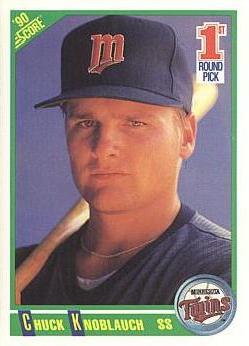
The Common Man has forever been fascinated with Chuck Knoblauch, so when Craig Calcaterra asked readers to identify the most hated player in each team’s history, TCM immediately went to Knobby as his default answer. Knoblauch came up for the Twins in 1991, finally providing the Twins with solidity at the position for the first time since 1985. He won the Rookie of the Year Award, and even excelled in the postseason, hitting .326 with 8 runs scored. Knoblauch would quickly become a fan favorite for his small stature, obvious hustle, and his excellent play. He was essentially David Eckstein’s much, much better older brother.


The Twins rewarded an incredible 15.3 WAR run from 1995-1996 with a five year contract extension for around $30 million, making him one of the highest paid players in the game. But before the end of August of 1997, less than a season into the new deal, Knoblauch expressed his frustration with the Twins and “requested” to be traded to another club, with the Yankees on the top of his wish list. There was a competing offer from the Indians that reportedly would have netted the Twins Chad Ogea, Steve Karsay, and Enrique Wilson, but thankfully the Twins didn’t bite. Instead, Knoblauch got his wish and was shipped to the Bombers for Eric Milton, Christian Guzman, Brian Buchanan, and $3 million.

Twins fans, naturally, didn’t take Knoblauch’s departure well, booing him lustily whenever the Yankees came to town, and showering him with batteries and other trash when he tried to play leftfield in 2001. It’s likely there is no more hated figure in Twins history.

But here’s the thing, the Knoblauch trade was ridiculously good for the Twins, and the club continues to see benefits today. Check out Chuck Knoblauch’s family tree: