Showing posts sorted by relevance for query Mussina. Sort by date Show all posts

Monday, March 30, 2009

Moose Hunting

Lar's retrospective on the career of Mike Mussina yesterday on wezen-ball, ended on an interesting note:

"The last eight years of his career, though, which he spent on the Yankees, were not nearly as good as his first. Whether this is a product of his complacency after signing a big contract, or a result of the pressure of pitching in New York City, or just a natural result of his aging (after all, he didn't sign with the Yankees until he was 32), it's hard to say. It is clear that those Yankees years were not up to the standard that he set for himself in Baltimore, and that seems to be the main reason that some people don't remember him as being great."


That stuck in The Common Man's craw, and he started to wonder what, if anything, happened to Mussina during the move from The Charm City to The Big Apple. Now, The Common Man should preface this by saying that he is not a number cruncher by trade, and that some of the conclusions here may be rough. He leaves it to those with better resources and more time at their disposal (or just to the peanut gallery of armchair bloggers) to figure out if The Common Man is on to something here. All statistics were derived from that trustiest of trusty sites, baseballreference.com.

Here are Mussina's rate stats for his time as an Oriole and a Yankee:

Orioles ERA: 3.53
Yankees ERA: 3.88

Orioles K/9: 6.9
Yankees K/9: 6.2

Orioles BB/9: 2.1
Yankees BB/9: 1.8

Orioles HR/9: .94
Yankees HR/9: .96

As you'd expect, the raw data seems to indicate that Lar is right. Moose's ERA is a third of a run higher as a Yankee, and his declining strikeout and walk rates seem to indicate a pitcher who's compensating for a loss of velocity. In addition, the relative stability of his homerun rate could be a result of moving from a good homerun park (Oriole Park at Camden Yards) to a more difficult one (Yankee Stadium). Like most pitchers, as he aged Mike Mussina had to survive by pitching more to contact.

And given the state of the Yankees defense, perhaps this was exactly the wrong time for Mussina to have to make this adjustment. In his prime, up the middle in Baltimore, Mussina had Ripkens (plural), Harold Reynolds, Mike Devereaux, Robbie Alomar, Brady Anderson, and Mike Bordick, all players with excellent defensive repuations. Meanwhile, as a Yankee, he's had Soriano, Jeter, Miguel Cairo, an aging Bernie Williams, Robinson Cano, Johnny Damon, and Melky Cabrera. Defense has not been a hallmark of the Yankees of late, and Mussina's shift in pitching strategy seemed destined to lead to more basehits.

Indeed, if one crunches the defensive numbers, Mussina's Orioles allowed a .293 average on balls in play, while his Yankees allowed a .298 batting average. As Mussina's strike out rate dropped, one would assume that this more porous defense would affect his overall performance even greater. And indeed Mussina gave up 8.5 hits/9 as an Oriole, but 9.1 as a Yankee. And given how many Baltimore singles may have ended up as New York gappers, perhaps it's not a stretch to say that the majority of Mussina's problems in New York were caused by the disappointing defense playing behind him, rather than the attrition of his ability (during which he maintained a respectable K/9).

The case is, of course, far from proven. There's significant noise in that data and a lot of logical leaps that The Common Man made. Perhaps as Mussina gets closer to his enshrinement in the Hall of Fame, others can do some of the heavier lifting, and demonstrate just how effective Moose remained in the Yankee years, and how deserving he is of baseball's highest honor. In the meantime, since it seems to bring you people back in droves (and The Common Man does love droves), here's Mike Mussina's Strat-o-Matic card from his fabled 1992 season (18-5, 2.54 ERA, 48 BB, 16 HR, 130 K in 241 IP, and a 157 ERA+):


As you can see, Mussina has a pronounced reverse platoon split. He allows fewer hits and less power to lefties (in his real season, lefties managed to hit just .220/.269/.280 off Moose, with just one homer in 459 plate appearances), has a strong ability to induce the double play (any grounder with an A next to it is a DP), and can go deep into games (8 innings without tiring). He even holds runners well, automatically decreasing their chances of stealing second by 15% (the hold -3 rating). In all, this is what The Common Man dreams about at night, when he thinks about the perfect pitcher. And only 23!

Thursday, May 14, 2009

Random Thursday: June 13, 1995, Baltimore vs. Cleveland

Do you remember back before the season, everyone was a bit abuzz over Mike Mussina. Lar at wezenball had a post up. Jason at It's About the Money Stupid, Shyster was weighing in. There was a general desire to assess and dissect the man’s career, to decide his place among the games’ elites. Even The Common Man himself weighed in concluding that “it's not a stretch to say that the majority of Mussina's problems in New York were caused by the disappointing defense playing behind him, rather than the attrition of his ability.”

But lest we forget, all was not wine and roses for Mussina in Baltimore. For instance, in this week’s randomation, we find a June 13, 1995 contest between Mussina’s Orioles and the eventual AL Champion Cleveland Indians, who won 100 games in just 144 contests. In that strike-shortened year, the Orioles got great work out of Mussina, who went all 19-9, 3.29, 2.0 BB/9, 3.16 K/BB, and 1.069 WHIP on the American League in 221.2 innings (Randy Johnson won the Cy Young that year, but Mussina inexplicably finished 5th, behind Jose Mesa (who got two first place votes (raise your hand if you’re the idiot who voted for him…)), Tim Wakefield, and David Cone). However, his Orioles finished 71-73, good for 3rd place in the AL East.

This game is notable for a number of reasons. First off, it’s a terrible rout. The Indians touched up Mussina for a three run homer (by 3B(!) Jim Thome) and a solo shot (Albert Belle). He left after 5.2 innings, having given up 6 runs. His replacements weren’t much better. Jamie Moyer relieved and gave up three straight singles to Thome, Manny Ramirez, and Paul Sorrento before giving way to Alan Mills. Mills got out of the 6th without further damage, but couldn’t record an out in the 7th. He gave way to Jesse Orosco, who allowed a couple of sac flies. By the end of the 7th, the Indians had an 11-0 lead, which they would hold. El Presidente, Dennis Martinez, pitched the shutout for Cleveland.

But an 11-0 drubbing is only so interesting. Great players have bad games. It's just the way of the world. More interesting here is the composition of the lineups and teams themselves. While these teams were qualitatively very different (and the Orioles were worse almost across the board that year), the career values of the two squads is incredibly interesting. Take a look at who played in this game:

Mussina--270 career wins
Moyer--249 career wins (and counting)
Martinez—245 career wins
Orosco—1252 games pitched (MLB record)
Doug Jones—303 career saves
Thome—547 HR (14th all time, and counting)
Belle—381 HR
Ramirez—533 HR (19th all time, and counting)
Eddie Murray—3255 H (12th all time), 504 HR, 1917 RBI (9th all time)
Omar Vizquel—2670 hits (and counting), 11 Gold Gloves
Kenny Lofton—2428 hits, 622 SB
Tony Pena—4 Gold Gloves
Rafael Palmeiro—3020 hits, 569 HR (10th all time), 1835 RBI (14th all time)
Harold Baines—2866 hits, 384 HR
And, of course,
Cal Ripken—3184 H (14th all time), 431 HR, 2630 consecutive games (ML Record), 2 Gold Gloves, 2 time AL MVP

And that’s not even counting three-time all stars Carlos Baerga and Brady Anderson.
Not appearing in that contest were Kevin Brown (211 wins), Dave Winfield (3110 H, 465 HR), Bobby Bonilla, Andy Van Slyke, Brian Giles, and Jeromy Burnitz.

These rosters were filled with players who either had had tremendous careers, or had tremendous careers ahead of them. In all, the pitchers in this game won 959 games, lost 725, saved 470, appeared in 4445, and threw 14403.7 innings. The hitters totaled 34771 hits, 4717 homers, 18,488 RBI, and 18561 R. In all, to The Common Man, that seems awfully prolific. In the post war era, this has got to be one of the most amazing accumulations of talent on one ball field, doesn’t it? The Common Man wonders if there’s a way to check that out without devoting the next six months of his life to the project. Class, any ideas?

Friday, February 4, 2011

The Ripple Effect

By The Common Man

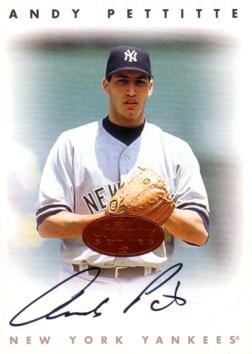
Now that he’s retiring, everybody seems to be wondering whether Andy Pettitte is going to be a Hall of Famer. The answer is likely that he doesn’t deserve to on merit, but there’s a distinct chance that his fame and his postseason success could push him over the top. But Pettitte is more interesting for how his candidacy touches on and affects the candidacy of others. What does The Common Man mean?


Sunday, December 5, 2010

40 Greatest New York Yankees

By The Common Man

As you know by now, Derek Jeter returned to the Yankees this weekend for the paltry sum of somewhere around $17 million per season for three seasons, with a possible 4th year option. It’s hardly worth Jeter’s time, as the single greatest player in the history of any sport ever, to even consider getting out of bed for $17 mil, but if he can will himself and his teammates to win surely he can motivate himself to play even when he is so drastically undervalued as to be playing for virtually nothing.

As all news, all the time, should be Jeter-centric, The Common Man is offering two companion pieces today and Tuesday, on the 40 greatest Yankees of all time and the 40 greatest SS. Feel free to argue in the comments section. That’s, obviously, what the comments section is for. Without further ado, the 40 greatest Yankees ever as determined by Baseball Reference.com’s Wins Above Replacement (WAR) as a Yankee.*

*Note, in certain cases, however, TCM has taken the liberty of adjusting certain rankings when a player missed time due to actual war (as opposed to WAR), and some slight adjustments based on both service time, peak value, and general glory as determined by World Series performance. TCM will try to make these cases apparent. Also, all statistics include only the time the player served as a Yankee.

Monday, August 23, 2010

Skippers' Sendoffs

By Bill

When Lou Piniella called it quits yesterday, it's not as though he was planning his perfect exit. You have to respect a guy for just realizing that his family situation required him to leave, even though that the leaving would be forever, even though he was leaving a team that was 51-73 and facing a much, much better team. This was to be how 49 or so years in pro ball all ended, and it didn't figure to be good.

And boy, wasn't it! The Cubs kept it to 5-3 entering the seventh, but then the Braves scored eleven runs in Piniella's last three career managerial innings, and it ended 16-5.

So I got to thinking: I think Piniella will probably be in the Hall of Fame eventually. Just the one World Series berth, but he's managed the 13th most games in big-league history, has the 14th most wins, a bunch of playoff appearances, that 116-win season, and of course has that memorable character and reputation.

So here's how it ended for the other Hall of Fame managers (those who are actually specifically in the Hall as managers):

Walter Alston: Astros 1, Dodgers 0 (loss)
Alston's almost-23-year run as manager of the Dodgers ended with just four games remaining in the 1976 regular season and his team at 90-68 (the last four games, and next twenty years or so, were handled by Tom Lasorda). Because I haven't been able to find the actual reason for the weird timing, I'll have to assume that he saw J.R. Richard's sparkling three-hit shutout (with, uncharacteristically, zero walks and just five strikeouts), running the 26 year old's record to 19-15, and figured he was finally beat once and for all. Actually, it's entirely fitting that the manager of the 1960s Dodgers went out on a 1-0 game.

Sparky Anderson: Orioles 4, Tigers 0 (loss)
Wow, two-for-two in shutout losses so far! George Lee Anderson stuck it out to the bitter end of the Tigers' 60-84, strike-shortened 1995 season. In the finale, Mike Mussina stymied them in a complete game, two-hit, two-walk, seven-K gem. Like Richard above, Mussina was 26 and won his 19th game in the great manager's walk-away loss. Buddy Bell took over for Anderson, and was...less successful than Lasorda.
This game was also the last for Lou Whitaker, making it the finale for the Trammell-Whitaker should-be-hall-of-fame keystone combo.

Ned Hanlon: Redlegs 13, Pirates 1 (win)
No boxscore available. Hanlon made the Hall (nearly sixty years after his death) on the strength of his work from 1894-1900, when he led Baltimore and Brooklyn teams to five NL pennants in seven years. There was nothing he could do for the 1906-07 Cincinnati squads, who went a combined 130-174 under Hanlon's helmsmanship. Leaving after the season was at least ostensibly Hanlon's decision. Just 49, he was invested in a Federal League team, and was involved in the landmark Supreme Court suit that ended up creating the deplorable MLB antitrust exemption.

Bucky Harris: Tigers 8, Cleveland 4 (loss)
The final game of Harris' 29 year managerial career brought his career record to within 61 games of the .500 mark (managing the Senators for 18 years can do that). "Shortstop" Harvey Kuenn went 3-for-5, 21 year old vet Al Kaline hit a two-run triple and Billy Hoeft came on in relief in the 4th inning to walk away with his 20th win on the last day of the season. The Tigers went 82-72, and it's not clear to me whether Harris left on his own terms or the Tigers'.

Whitey Herzog: Cardinals 4, Padres 1 (win)
Now this was a good one to go out on...if you had to leave in the middle of a terribly disappointing season. It was the Cards' 80th game in 1990, and raised their record to just 33-47. Tied 1-1 in the 9th, the Cards exploded to score three runs off of Greg Harris in a rally that, fittingly, included both a sacrifice bunt and a stolen base. Whitey was somewhat improbably replaced by 67 year old former Cards great Red Schoendienst, who kept the seat warm for Joe Torre for a few weeks.

Miller Huggins: White Sox 7, Yankees 0 (loss)
Pretty safe to say that Babe Ruth made Huggins a Hall of Famer, right (see also Lazzeri, Combs, Hoyt, etc.)? Anyway, this was another late-season exit, game 147 in the Yanks' 1929 season. Chicago pitcher Hal McLean walked six and gave up two hits to Ruth, but allowed just two other hits for the third shutout loss in six so far. Art Fletcher finished the season, then Bob Shawkey for 1930, and then some guy named McCarthy came in in '31.

Tommy Lasorda: Dodgers 4, Astros 3 (win)
The Dodgers scored two in the 8th off of Billy Wagner to tie it at 3, and then Mike Piazza, the kid of Tommy's family friend, won it with a walk-off homer in the bottom of the ninth. It would've been a perfect sendoff...except Lasorda had no intention to make it one. He had a heart attack the next day, officially ending his career a little over a month later. It also ended a pretty incredible run; Alston and Lasorda managed the Dodgers for a combined 43 seasons, and they've had six managers in the fifteen years since.

Al Lopez: Royals 5, White Sox 4 (loss)
A Joe Foy single in the bottom of the 12th ended Lopez' impressive career (no world championships but a .584 regular season winning percentage), just 17 games into the 1969 season, after which he retired. His final years with the Sox read like Billy Martin's time with the Yankees, but I'm not clear on whether he was getting fired or quitting/retiring.

Connie Mack: A's 5, Senators 3 (win)
The A's 52nd win against 102 1950 losses was the last win for Mack, who won 3731 of them (but lost even more) in 53 seasons before finally calling it quits at age 87.

Joe McCarthy: Tigers 10, Red Sox 2 (loss)
He made his name with the Cubs and (especially, of course) Yankees, but he'd also had great success in 1948 and '49 with the Sox. The 5th consecutive loss on June 18, 1950, though, dropped the team to just 31-28, and the 63 year old McCarthy was done. Ted Williams hit his 275th career home run in the losing effort. Steve O'Neill took over the rest of the way, and went 63-32.

John McGraw: Phillies 4, Giants 2 (loss)
McGraw's 33rd year as manager (and 30th as manager of the Giants) ended after just 40 games, in which the Giants had gone 17-23 and were in 8th place. The New Yorkers led 2-0 after six, but gave up one in the 7th and three in the 8th. I imagine McGraw just left in a disgusted huff and never looked back. The next manager, Bill Terry, lasted nine more seasons.

Bill McKechnie: Reds 6, Cardinals 0 (win)
As with Alston, McKechnie lasted until the team's final four games in his final season (1946, here), and as with Alston, I can't figure out why. Great one to go out on, though, as Bucky Walters and the Reds' defense blanked the eventual world champion Cardinals. He was replaced by Hank Gowdy, who only ever managed those four games (going 3-1).

Wilbert Robinson: Robins 12, Giants 3 (win)
Another long-termed Dodgers (er, Robins) manager, Robinson saw his 18th season with the team through to the end in 1931. His boys thumped the second-place Giants, with every player including the pitcher collecting at least one hit (mostly in the first three innings off Freddie Fitzsimmons). Joining the hit parade with a 2-for-4 was a 22 year old catcher named Al Lopez.

Frank Selee: Reds 6, Cubs 0 (loss)
No boxscores from 1905. Selee made the Hall of Fame (almost a century later) for his work with the Boston Braves before the turn of the century, but he'd had some success in Chicago. He started '05 a very respectable 37-28 but was replaced anyway by another Hall of Famer, Frank Chance, who went on to player/manage the team through easily the best seven years of its history.

Billy Southworth: Cubs 3, Braves 0 (loss)
Another shutout loss! The Boston squad, with which Southworth had been successful--if not nearly as successful as with his earlier work with the Cardinals -- in most of his first five seasons, fell to 28-31. Bob Rush threw a four-hit, four-K shutout. Tommy Holmes (hey, read about him here!) took over after the game as player/manager.

Casey Stengel: Phillies 5, Mets 1 (loss)
You'd probably guess Stengel's exit was horrid -- he finished with three and a half god-awful years at the head of the expansion Mets -- and you'd be right. Jim Bunning shut them down in a two-hit, 12-K complete game, running the Mets' 1965 record to 31-64 and Stengel's career Mets record to 175-504 (.302). I bet most people don't realize that even after 12 wildly successful years with the Yankees, Stengel's career record fell all the way back to just barely above .500 (.508, to be exact). Wes Westrum somehow suffered through most of the next three years, and then Gil Hodges took over and things got better.

Earl Weaver: Tigers 6, Orioles 3 (loss)
Joe Gibbs should've taken a lesson; Weaver tried to come back after just two and a third seasons off, and the magic was gone. The Orioles weren't terrible for most of 1986, but lost their last five games and ten of their final 13 to finish 73-89. Really nothing worth reporting about that final game. Cal Senior took over in '87, and certainly didn't do any better.

Dick Williams: Royals 7, Mariners 3 (loss)
Managing the late-eighties Mariners is not the way a Hall of Fame manager should have to end his career. He was canned after this ho-hum loss dropped them to 23-33 and 16 games out of first on June 5 of '88. There were a lot of great things in Williams' career, and Alvin Davis, Jim Presley and Rey Quinones played no part in any of them.

Quite a few ignominous endings in there, but nothing quite like the 16-5 drubbing Piniella took home with him yesterday.

Monday, November 14, 2011

Happy Birthday...

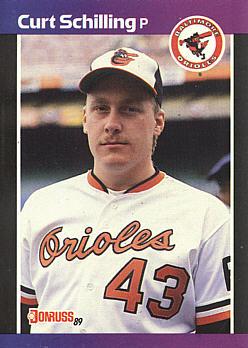
Curt Schilling!

Schilling is 45 today. It's a bit hard to believe, but he threw his last pitch four years and twenty days ago.

I think Schilling makes the Hall of Fame eventually, but it probably takes a while. It's a shame, because he's pretty comfortably deserving. Ignoring his postseason heroics (and I think those have to count for something; it's silly to credit a player for team success in the World Series and such, but not for particularly noteworthy individual performance), Schilling is 17th among pitchers in career WAR since 1950. Eleven of the sixteen in front of him are in the Hall, and the other five are Roger Clemens, Greg Maddux, Randy Johnson, Pedro Martinez and Mike Mussina. Three of those guys are guaranteed to make it, and Mussina certainly should. Also, Schilling's 69.7 WAR is better than Don Drysdale, Juan Marichal, Jim Palmer, Jim Bunning, and Whitey Ford (along with Catfish Hunter and a bunch of other Hall of Famers in name only).

Friday, February 4, 2011

Was Andy Pettitte Better Than His Numbers?

By Bill

Everybody knows by now that Andy Pettitte -- you remember, the guy that used PEDs just like everybody else but it's totally OK because he seems like a nice guy? -- announced yesterday that he would retire rather than returning to the Yankees for 2011. The question that immediately comes up, then, is: is Andy Pettitte a Hall of Famer?

Aaaand...that's not what this post is about, not really. My answer, based on his career (regular-season) numbers and accomplishments as they stand, is no, and not particularly close. If you ignore the wins (as all reasonable people do), there's nothing about his record that really looks anything at all like a Hall of Famer. He had one great year (1997), a couple other really good ones, and about twelve more in which, by and large, he was just a touch above average. His career bWAR is 50.2, better than a handful of weaker HOF starting pitchers but less good than Kevin Appier, Brett Saberhagen, Chuck Finley, Dave Stieb, David Cone and Jerry Koosman. By ERA+, Pettitte's 116 is pretty nice, but just 31st among non-Hall of Famers with between 2500 and 3500 innings pitched (Pettitte threw 3055), and doesn't compare very well at all to no-chance guys like Billy Pierce, Stieb, Carl Mays, or Kevin Brown, among others. I don't think there's any reasonable argument, not based on the absurd fiction of pitcher "wins," that puts Pettitte all that close to the Hall of Fame based on the stats you'll find at Baseball-Reference or FanGraphs.

But the question, I guess, is: is Pettitte somehow better than his raw numbers? There are two arguments I've heard hinted at today that kind of suggest that he was, and I'll deal with them separately here:

Thursday, December 2, 2010

My Hall of Fame Ballot

By Bill

Last year at this time (more or less), in connection with my Baseball Bloggers Alliance voting, I wrote up a big post passing judgment on every single player on that year's Hall of Fame ballot.

Well, this year's ballot just came out, and I just voted for the BBA again, so I figured it was time to do another one of these posts.  The nice thing, though, is that none of the seven guys I would have voted for last time made it in, and I haven't had cause to reconsider those seven or any others.  So that'll save me a lot of work: I'll just do the new guys.  If you want my take on any of the others, just click the link above!

My carryover yeses, in alphabetical order: Roberto Alomar, Bert Blyleven, Barry Larkin, Edgar Martinez, Mark McGwire, Tim Raines, and Alan Trammell.  Now on to the new guys:

Friday, April 22, 2011

This Week in 2001 (Week 3)

By Bill

Another week, another update from a decade ago. The program I use to clip out my favorite tweet of the week (this one) is on the fritz at the moment, so we'll just dive right in:

Monday, April 16: After another masterful performance by Greg Maddux (8 innings, 0 BB, 6 K, one unearned run), John Rocker enters with a 3-1 lead and, after two singles, a wild pitch, a passed ball, and a walk, it's 3-3, Rocker's second blown save of the year. He gets credit for the "win," though, when Rico Brogna's line drive single to right off of Dan Miceli (following two walks) scores B.J. Surhoff. Braves 4, Marlins 3.

Friday, April 8, 2011

This Week in 2001 (Week 1)

By Bill

A few days ago on Twitter, I started something I hope to keep up all season: one tweet a day that highlights something that happened on this date 10 years ago, in 2001. That season was one of the most interesting and action-filled in recent memory, and it's hard to believe that it was already a whole decade ago, so I thought it would be fun to kind of re-live the year in real time. Here's the first tweet:


So that's the idea. In connection with the Twitter effort, I've decided to write a weekly wrap-up, this Friday and hopefully every Friday, of what happened in baseball "this week" a decade ago (and it actually works out pretty well, as Saturday through Friday in our world was Monday through Sunday in 2001). So here's a look at a couple interesting notes from each day in the opening week:

Tuesday, March 1, 2011

HOF Voting Predictions Recap: Who'd We Miss?

By Bill

So last week, The Common Man and I took on the daunting and ultimately pretty silly task of predicting how the next 25 years of BBWAA Hall of Fame voting would go. The five-part set of summaries is right here (1, 2, 3, 4, 5), and now, you can see all the results together in an ugly little spreadsheet here.

I picked 52 inductees, and TCM picked 51. Forty names appear on both of our lists, which you could look at a few different ways -- either 77.7% of the total names matched (80/103), or 63.5% of the players picked were picked by both of us (40/63). The second way is probably more meaningful, but either way, it seems to me like quite a lot of agreement for something this wide open. On the chart linked above, the players who were picked by only one of us are highlighted in red.

On the other hand, there are 18 players (28.6% of the total players or 35% of all our picks) who we not only both picked, but both picked to go in in the same year. These come primarily in the first several years, as you might guess -- Biggio, Maddux, and Griffey are the easy ones -- but there were some pretty random agreements down the road, too. Most notably, we both have Mauer and Sabathia going in in 2026 somehow, and we both picked Buster Posey for 2032 and Jason Heyward for '35. All those perfect matches are highlighted in yellow.

Here's a look at some of the key players we disagreed on, followed by some players we skipped completely:

Friday, July 22, 2011

Baseball Teams' Blind Spots and Burned Bridges

By Bill


On Twitter on Wednesday, a tweet (this one) from the Atlanta Journal-Constitution's David O'Brien indicated that the Braves "could be close to making a deal for a [right-handed] bat," which started a ton of speculation about who it could be. And one thing quickly became very, very clear, if you didn't realize it already:

Braves fans (and bloggers) really, really hate Jeff Francoeur. Really.

On paper or in a video game, if you're the Braves and are looking for a right-handed outfielder (which the "bat" in question is assumed to be), you could do worse than Jeff Francoeur. He's not a good baseball player, but he can certainly be a useful one, with a .300/.344/.495 career line against lefties, .315/.357/.640 in 2011, and at least decent defense. It's not an exciting add, but considering the only righty outfielder on the team's roster right now is transplanted second baseman Martin Prado, who hits pretty well for a second baseman and has a .383 2011 slugging percentage against lefties, he'd be an improvement.

In the real world, though, the Braves would be risking an overwhelming fan backlash. Francoeur was the homegrown golden boy who went bad and left town and who really, really can't go home again.

And it occurred to me that for every team, there has to be one guy the fanbase just can't possibly be rational about -- whether it's irrational love, or irrational hate, or (in more cases than you'd think) healthy measures of both. No matter how much sense Francoeur might make for the Braves, it would never not cause a riot, and that's not just a Braves thing. I raised this on Twitter, and I got more responses than I'd ever gotten for anything, everyone chiming in with their pick for their own team. So, with a lot of subjectivity and heavily informed by my Twitter friends, here's your list:

NL Central
Cubs: Milton Bradley.
Alfonzo Soriano, Kerry Wood and Carlos Zambrano are each irrationally loved and/or hated enough to lead the way on most teams, but the Bradley experience in the North Side is a whole 'nother thing. The whole comment thread here gives you a taste.