By Bill
We've known it was coming for a while now, but yesterday it was made more or less official, with the approval of the sale of the Astros to Jim Crane: the Astros will be moving to the AL West, most likely in 2013, giving each division five teams. And it seems a foregone conclusion that another change is headed our way by the 2013 postseason, and perhaps as early as next season, with the addition of two more wild cards, with the two wild cards from each league meeting in a one-game playoff (or play-in, if you will) to determine who advances to the traditional five-game LDS.
In the interest of full disclosure and all that: on this one issue, I'm kind of a traditionalist. Yes, I'd like to see instant replay and/or robot umpires in every feasible instance, including, if possible, computerized ball/strike calls. But here, I'm a regular Bob Costas or Billy Crystal. We've been in the wild card era for eighteen years now, and I'd still really love to see them go back to the four-division, two-playoff-round format that subsisted from 1969 to 1993, and if I'd been alive for the old no-division, two-league, winner-goes-to-the-Series format that had been in place from the turn of the century through '68, I'd probably be in favor of that instead.
It's not entirely nostalgia, though. The thing is that while what happened this year -- the Cardinals winning it all despite being, in terms of full-regular-season performance, probably the worst team in the postseason -- can be fun in its own way, I'd really prefer to see the best team from each league in the Series, or at least to be given a really good chance of getting there. Every expansion to the playoffs cheapens the regular season a little bit. If American League Team X won 105 games in the regular season, and American League Team Y won 88, in almost every case, we already know beyond the shadow of a doubt that X is a better team than Y, so having the two face off in a short series, in which anything can happen, seems counterproductive.
Showing posts with label Bud Selig. Show all posts
Friday, November 18, 2011
Friday, April 15, 2011
Jackie Robinson: Love the Man, Hate the Day
By Bill
Below is a reprinting of one of the first baseball blog posts I ever wrote, two years ago today, under the slightly more cynical headline "Doritos Jackie Robinson Day Presented by Cialis." Not many things hold up after two years in the baseball-blogging world, but Bud Selig and MLB are again cheapening Jackie's memory by forcing every player in baseball to "honor" him by wearing his number, so it seems to me it's worth hauling this out again.
Labels:
baseball,
Bud Selig,
Jackie Robinson
Monday, March 21, 2011
What the End of the Selig Era Looks Like
By The Common Man
(Note: This column was originally slated to run on ESPN's SweetSpot blog, but was one of two stories by The Common Man that was "spiked" for being "totally inappropriate." The other column is here.)
I don’t like Bud Selig. You don’t like Bud Selig. None of us really likes Bud Selig. And yet, despite several PR nightmares, such as the strike in 1994, the All Star Game tie in 2002, and the steroid scandal in the late 1990s and early 2000s, as his epoch as the Commissioner of Baseball winders down, baseball seems to be in a relatively good place. Revenues are up. Attendance is relatively strong. There is labor peace. Baseball has its own TV network. The owners are pretty organized. But the public perception of Bud Selig has continued to lag. The reasons for this are easy to see. He’s still acts like a bit of a boob. He’s still seen as a little clueless. He follows the tradition of creatively named commissioners (Happy, Bowie, Ford, Kenesaw, Fay). Indeed, he’s still not terribly popular outside of Milwaukee, where he will always pretty much be a patron saint.
And rightfully so. When baseball has struggled, so has the commissioner. He’s been a reflection of baseball’s failings and strengths over the last 20 years. He’s struggled to explain why baseball didn’t respond sooner to steroids. He’s looked clueless as the spectacle of the All Star game turned into a debacle. When baseball’s excesses have taken the stage, Bud’s proven ill-equipped to put out public firestorms, and often exacerbated the problem by undermining the game itself (such as by saying that “small market” teams couldn’t compete). Someone with more P.R. sense might have managed to make lemonade out of baseball’s lemons (or at least a decent G&T), but Bud’s only managed to pour juice into baseball’s wounds. He’s tried so hard to be the commissioner that fans need and want, but he’s ultimately the commissioner baseball deserves. One who publically seems incompetent while privately marshaling forces and keeping the ship on course (even if it isn’t always steady).
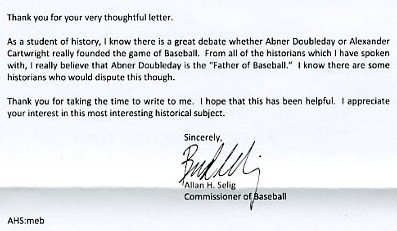
Earlier this offseason, Bud made the ship wobble a little when he told autograph expert Ron Keurajian that “As a student of history, I know there is a great debate whether Abner Doubleday or Alexander Cartwright really founded the game of Baseball. From all the historians which I have spoken with, I really believe that Abner Doubleday is the ‘Father of Baseball.’” And now, according to Gordon Edes, he’s apparently decided he needs a committee to investigate this myth, bringing in noted historians John Thorn, Ken Burns, and Doris Kearns Goodwin, among others.
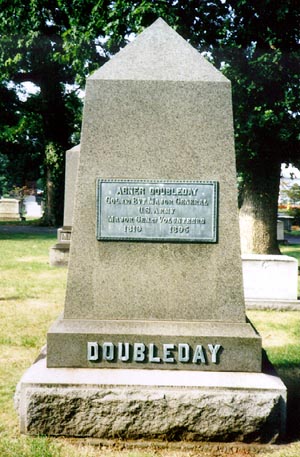
This is, of course, ridiculous. The myth of Abner Doubleday comes via another commissioner-convened committee that was charged to explore the game’s origin. The Mills Commission of 1905 used the testimonial letter of 71-year old Abner Graves (a man who soon after sending it murdered his wife and was committed to a mental asylum) to declare that Doubleday invented the game in 1839 on the shores of Lake Otsego near Cooperstown, New York (despite the fact that Doubleday was enrolled at West Point at the time). Frankly, you probably know most of this story if you’ve ever watched Ken Burns’ documentary. You also may have read similar versions of the story in John Thorn’s Baseball In the Garden of Eden or Harold Seymore and Dorothy Jane Mills’ Baseball: The Early Years. Or seen MLB.com’s documentary on it (h/t to Craig Calcaterra).
So what gives? Why in the world would we need a committee to investigate what everyone already knows? Forming committees gives the impression of action. Bud Selig isn’t actually going to do anything. But in putting the committee together, it looks like he is. And when the group comes back with its findings,* Bud will get to stand up at a podium and announce the results. And he will get to look the part of the commissioner, even if he’s accomplished absolutely nothing. Commissioner Bud loves committees. After all, he’s had the committee to determine whether the Oakland A’s can move to San Jose meeting since March of 2009. He’s had a special committee for on-field matters (which has yet to recommend anything meaningful) and a blue-ribbon committee to recommend changes to the playoffs (which streamlined the playoff structure). But every time they meet, Bud Selig gets to stand in front of a podium and act like a commissioner.
*And really, the meeting should go something like “Anybody here think Abner Doubleday invented baseball? Put your hand down, Mr. Selig. No one else? OK, what’s for lunch?”
Bud’s time as a commissioner is winding down. He’s 76 years old. He’s supposedly set to retire after 2012 (though he’s had his contract unexpectedly renewed before). This is the time when the head of any organization starts to think about his legacy, and how he will be remembered. Bud’s looking for more opportunities to act like the commissioner we wish he were, rather than the one he’s been. So expect more of this. More grandstanding, more pronouncements, more committees. You’re going to see a lot more of Commissioner Bud as he puts his final stamp on the game that he has served (and which has served him) for so long. He can’t give up trying to be the commissioner that baseball needs, rather than the one it deserves.*
*I think what I’m saying is…Bud Selig is Batman.
(Note: This column was originally slated to run on ESPN's SweetSpot blog, but was one of two stories by The Common Man that was "spiked" for being "totally inappropriate." The other column is here.)
I don’t like Bud Selig. You don’t like Bud Selig. None of us really likes Bud Selig. And yet, despite several PR nightmares, such as the strike in 1994, the All Star Game tie in 2002, and the steroid scandal in the late 1990s and early 2000s, as his epoch as the Commissioner of Baseball winders down, baseball seems to be in a relatively good place. Revenues are up. Attendance is relatively strong. There is labor peace. Baseball has its own TV network. The owners are pretty organized. But the public perception of Bud Selig has continued to lag. The reasons for this are easy to see. He’s still acts like a bit of a boob. He’s still seen as a little clueless. He follows the tradition of creatively named commissioners (Happy, Bowie, Ford, Kenesaw, Fay). Indeed, he’s still not terribly popular outside of Milwaukee, where he will always pretty much be a patron saint.
And rightfully so. When baseball has struggled, so has the commissioner. He’s been a reflection of baseball’s failings and strengths over the last 20 years. He’s struggled to explain why baseball didn’t respond sooner to steroids. He’s looked clueless as the spectacle of the All Star game turned into a debacle. When baseball’s excesses have taken the stage, Bud’s proven ill-equipped to put out public firestorms, and often exacerbated the problem by undermining the game itself (such as by saying that “small market” teams couldn’t compete). Someone with more P.R. sense might have managed to make lemonade out of baseball’s lemons (or at least a decent G&T), but Bud’s only managed to pour juice into baseball’s wounds. He’s tried so hard to be the commissioner that fans need and want, but he’s ultimately the commissioner baseball deserves. One who publically seems incompetent while privately marshaling forces and keeping the ship on course (even if it isn’t always steady).
| Image via Hauls of Shame |
This is, of course, ridiculous. The myth of Abner Doubleday comes via another commissioner-convened committee that was charged to explore the game’s origin. The Mills Commission of 1905 used the testimonial letter of 71-year old Abner Graves (a man who soon after sending it murdered his wife and was committed to a mental asylum) to declare that Doubleday invented the game in 1839 on the shores of Lake Otsego near Cooperstown, New York (despite the fact that Doubleday was enrolled at West Point at the time). Frankly, you probably know most of this story if you’ve ever watched Ken Burns’ documentary. You also may have read similar versions of the story in John Thorn’s Baseball In the Garden of Eden or Harold Seymore and Dorothy Jane Mills’ Baseball: The Early Years. Or seen MLB.com’s documentary on it (h/t to Craig Calcaterra).
So what gives? Why in the world would we need a committee to investigate what everyone already knows? Forming committees gives the impression of action. Bud Selig isn’t actually going to do anything. But in putting the committee together, it looks like he is. And when the group comes back with its findings,* Bud will get to stand up at a podium and announce the results. And he will get to look the part of the commissioner, even if he’s accomplished absolutely nothing. Commissioner Bud loves committees. After all, he’s had the committee to determine whether the Oakland A’s can move to San Jose meeting since March of 2009. He’s had a special committee for on-field matters (which has yet to recommend anything meaningful) and a blue-ribbon committee to recommend changes to the playoffs (which streamlined the playoff structure). But every time they meet, Bud Selig gets to stand in front of a podium and act like a commissioner.
*And really, the meeting should go something like “Anybody here think Abner Doubleday invented baseball? Put your hand down, Mr. Selig. No one else? OK, what’s for lunch?”
Bud’s time as a commissioner is winding down. He’s 76 years old. He’s supposedly set to retire after 2012 (though he’s had his contract unexpectedly renewed before). This is the time when the head of any organization starts to think about his legacy, and how he will be remembered. Bud’s looking for more opportunities to act like the commissioner we wish he were, rather than the one he’s been. So expect more of this. More grandstanding, more pronouncements, more committees. You’re going to see a lot more of Commissioner Bud as he puts his final stamp on the game that he has served (and which has served him) for so long. He can’t give up trying to be the commissioner that baseball needs, rather than the one it deserves.*
*I think what I’m saying is…Bud Selig is Batman.
Labels:
baseball,
baseball history,
Bud Selig
Wednesday, February 18, 2009
Around the Horn
It sounds like Shysterball's 25 baseball things idea has really taken off.
And now Rob Neyer, the Zen master himeself, is threatening to jump in. The Common Man looks forward to reading everyone's. If you don't have a blog, feel free to use the comments section here to post them, or if you do have a list up somewhere, feel free to leave a link (they certainly don't have to be as The Common Man's). If there isone thing that The Common Man thinks you and he can agree on (unless your name is BikeMonkey), it's that it's awfully fun to listen to why other people love the game and to compare it to our experiences. So share and enjoy.
Speaking of BikeMonkey, The Common Man feels badly that he's not down with teh baseballz. But really, The Common Man doesn't understand how anyone can not like baseball. The Dentist, The Common Man's little brother, hated baseball when he was a boy, choosing soccer instead like the rest of his friends. But with the wisdom of age, The Dentist has come to love watching the game, and follows it with nowhere near the intensity of his big bro. But it's still a big step. The Common Man doesn't know why BikeMonkey's such a stick in the mud, but most people who profess to hate the game claim that it's boring and slow. The prefer the up and down action of basketball or the explosiveness of football. Meanwhile, baseball is often a slow build, like a truly good film or song, adding tension and excitement as the game progresses until it reaches a fever pitch in the late innings. In between, it's a collection of exciting moments that are largely disconnected from one another. It takes a sophisitcation and appreciation of the finest things to appreciate baseball. A knowing patience. And because of this patience and willingness to wait for the final payoff, The Common Man likes to believe that baseball fans make the best lovers. Generous and willing to prolong the experience, baseball fans aren't interested in the quick and dirty slam-bam-thank-you-mamn (or sir),
but the drawn out, tantalizing prospect of making love. All night. Isaac Hayes style. The Common Man does not say this to disparage BikeMonkey, who The Common Man knows has the ability to appreciate and love the game, but to challenge him.
Meanwhile, The Common Man feels bad not a whit for MLB Commissioner Bud Selig, who told reporters Monday, "I don't want to hear the commissioner turned a blind eye to [steroids in baseball] or he didn't care about it. That annoys the you-know-what out of me. You bet I'm sensitive to the criticism." Bud's been awfully quick to slough off responsibility for the steroid era in the past, and to dump it on the players (who, deserve a large share of the blame, no doubt). But to eschew responsibility entirely is childish and disingenuous. No Mommy, Little Bud has no idea how the lamp got broken. He admits, "A lot of people say we should have done this or that, and I understand that. They ask me, 'How could you not know?' and I guess in the retrospect of history, that's not an unfair question" but goes on to equivocate and tout his past failed attempts to get a drug policy (starting in 1995, if Bud is to be believed). But here's the thing, those attempts were brought up in private negotiations and used as a bargaining chip. At some point, what Selig doesn't say is, he decided that wringing an extra year of player control or a slightly lower major league minimum or a bigger share of the broadcasting rights was worth trading for the testing. Mark The Common Man's words, if Bud Selig and Major League Baseball had truly wanted and was committed to institute a steroid testing policy in 1995, they could have gotten it. So for Bud Selig to say today that he's not to blame for the steroid era is, frankly, silly. There's plenty of blame to go around. The players, the owners, the union the management, the media, the fans, and the commissioner all share various amounts of it. So man up, Bud, and face the fact that you exchanged doping for dollars years ago, and are just now reaping the consequences of that choice. If you're happy to accept praise for the decision to expand the playoffs, start the MLB Network, and grow revenues, you must be willing to accept the littlest bit of responsibility for your stunning ability to look the other way.
The Common Man wants to add his congratulations to Sean Foreman, the founder and creator of baseballreference.com for selling a minority stake in his website and business to Fantasy Sports Ventures. Baseball Reference is a tremendous resource that any serious baseball fan needs to be using, like, all the time and it will play a large role in tomorrow's post (oh, see how The Common Man teases you).

No one is more deserving of the big payday than Sean for providing such an awesome free service to the public.
And now Rob Neyer, the Zen master himeself, is threatening to jump in. The Common Man looks forward to reading everyone's. If you don't have a blog, feel free to use the comments section here to post them, or if you do have a list up somewhere, feel free to leave a link (they certainly don't have to be as The Common Man's). If there isone thing that The Common Man thinks you and he can agree on (unless your name is BikeMonkey), it's that it's awfully fun to listen to why other people love the game and to compare it to our experiences. So share and enjoy.Speaking of BikeMonkey, The Common Man feels badly that he's not down with teh baseballz. But really, The Common Man doesn't understand how anyone can not like baseball. The Dentist, The Common Man's little brother, hated baseball when he was a boy, choosing soccer instead like the rest of his friends. But with the wisdom of age, The Dentist has come to love watching the game, and follows it with nowhere near the intensity of his big bro. But it's still a big step. The Common Man doesn't know why BikeMonkey's such a stick in the mud, but most people who profess to hate the game claim that it's boring and slow. The prefer the up and down action of basketball or the explosiveness of football. Meanwhile, baseball is often a slow build, like a truly good film or song, adding tension and excitement as the game progresses until it reaches a fever pitch in the late innings. In between, it's a collection of exciting moments that are largely disconnected from one another. It takes a sophisitcation and appreciation of the finest things to appreciate baseball. A knowing patience. And because of this patience and willingness to wait for the final payoff, The Common Man likes to believe that baseball fans make the best lovers. Generous and willing to prolong the experience, baseball fans aren't interested in the quick and dirty slam-bam-thank-you-mamn (or sir),
but the drawn out, tantalizing prospect of making love. All night. Isaac Hayes style. The Common Man does not say this to disparage BikeMonkey, who The Common Man knows has the ability to appreciate and love the game, but to challenge him.
Meanwhile, The Common Man feels bad not a whit for MLB Commissioner Bud Selig, who told reporters Monday, "I don't want to hear the commissioner turned a blind eye to [steroids in baseball] or he didn't care about it. That annoys the you-know-what out of me. You bet I'm sensitive to the criticism." Bud's been awfully quick to slough off responsibility for the steroid era in the past, and to dump it on the players (who, deserve a large share of the blame, no doubt). But to eschew responsibility entirely is childish and disingenuous. No Mommy, Little Bud has no idea how the lamp got broken. He admits, "A lot of people say we should have done this or that, and I understand that. They ask me, 'How could you not know?' and I guess in the retrospect of history, that's not an unfair question" but goes on to equivocate and tout his past failed attempts to get a drug policy (starting in 1995, if Bud is to be believed). But here's the thing, those attempts were brought up in private negotiations and used as a bargaining chip. At some point, what Selig doesn't say is, he decided that wringing an extra year of player control or a slightly lower major league minimum or a bigger share of the broadcasting rights was worth trading for the testing. Mark The Common Man's words, if Bud Selig and Major League Baseball had truly wanted and was committed to institute a steroid testing policy in 1995, they could have gotten it. So for Bud Selig to say today that he's not to blame for the steroid era is, frankly, silly. There's plenty of blame to go around. The players, the owners, the union the management, the media, the fans, and the commissioner all share various amounts of it. So man up, Bud, and face the fact that you exchanged doping for dollars years ago, and are just now reaping the consequences of that choice. If you're happy to accept praise for the decision to expand the playoffs, start the MLB Network, and grow revenues, you must be willing to accept the littlest bit of responsibility for your stunning ability to look the other way.The Common Man wants to add his congratulations to Sean Foreman, the founder and creator of baseballreference.com for selling a minority stake in his website and business to Fantasy Sports Ventures. Baseball Reference is a tremendous resource that any serious baseball fan needs to be using, like, all the time and it will play a large role in tomorrow's post (oh, see how The Common Man teases you).

No one is more deserving of the big payday than Sean for providing such an awesome free service to the public.
Labels:
25 random things,
baseball,
BikeMonkey,
Bud Selig,
steroids
Subscribe to:
Posts (Atom)