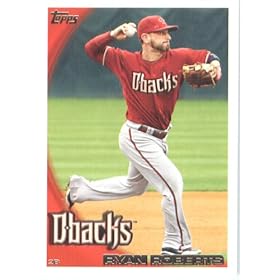
Back in May, when the SweetSpot Network was a bit smaller than it is now and we were routinely called upon to make comments on teams other than the Angels or White Sox on ESPN's Power Rankings, I drew the assignment of writing something up about the Diamondbacks. Widely picked to finish in or near last place in the NL West, the D-Backs had started out roughly as everyone predicted, but then rattled off six straight wins, ending the day on Sunday, May 22 at a surprising 23-23, with one more run scored than allowed. They'd shocked the world, basically, by being middle-of-the-pack for a month and a half.
My ESPN comment was skeptical, and I followed it up with a post with the following intentionally inflammatory title: Power Rankings Explained: Why the Diamondbacks Still Stink. The points were basically that (a) four of their six straight wins had been by one run, three against the Twins; (b) a journeyman named Ryan Roberts had been their best player; (c) Chris Young, on whom the offense heavily depended, had been terrible; (d) the pitching after Daniel Hudson and Ian Kennedy (who themselves were question marks) looked awful; and (e) other than a potential emergence from Justin Upton, there just wasn't anything else to get excited about. I saw them as "an 85- or 90-loss team," finishing in third or fourth place behind the Giants, Rockies, and possibly even Dodgers.
Well. Since then, through Monday, Arizona's gone 66-42 (.611), close to a 100-win pace. Their run differential hasn't been quite as good at all that, but it's clear that, for the season, they've been legitimately the best team in their division. They've topped the Giants by nearly ten games in that span, while the Rockies simply packed it in early, so there's really not been much competition.
So, I was wrong. But yet, you look at this team, and it's just hard to see a 90-plus game winner. What went right?
Showing posts with label Arizona Diamondbacks. Show all posts
Wednesday, September 21, 2011
Monday, May 23, 2011
Power Rankings Explained: Why the Diamondbacks Still Stink
By Bill
I don't do this often, because I think my comments to the ESPN Power Rankings more or less speak for themselves. But when I rip on a team coming off a 6-0 week, I suppose it's worth an explanation. Here's what I had to say about the Diamondbacks:
A six-game winning streak like the one the Diamondbacks are currently riding is always nice, but it's worth noting that four of the those six wins were by one run, and three of the six came against the Twins. Their stay at .500 may be a short one.
And here, in addition to the good luck and bad opponents they've faced this week, is why they're no good:
Labels:
Arizona Diamondbacks,
power rankings
Monday, May 16, 2011
NL Power Rankings Comments Explained
By The Common Man
When the ESPN Power Rankings come out, we're restricted to just a couple of quick sentences with each team. TCM's a lot more long-winded than that, so he's compelled to expand on those comments some more, and provide some context. So, without further ado, here are the Diamondbacks, Pirates, and Marlins.
Monday, May 2, 2011
NL Power Rankings Comments Explained
By The Common Man
Once again, ESPN’s Power Rankings are up, and The Common Man contributed the comments for the four NL clubs that are not currently covered in the SweetSpot Network. And as before, TCM wants to expand on the comments he provided for each club, the Rockies, Marlins, Pirates, and Diamondbacks:
Monday, April 18, 2011
Power Rankings Explained
By The Common Man
Every week, Bill and The Common Man are asked to help out our friends at ESPN with a brief comment for the Monday Power Rankings about each of the seven teams that are not represented in the SweetSpot network. We work hard on these, but ultimately only get a sentence or two to get our points across, so we thought it might be worth our time and yours to give you a slightly longer take on the larger overall points we were trying to make. So every week, when we have more to say, we will expand on those thoughts here. Today, The Common Man breaks down the Rockies, Diamondbacks, Marlins and Pirates.

Every week, Bill and The Common Man are asked to help out our friends at ESPN with a brief comment for the Monday Power Rankings about each of the seven teams that are not represented in the SweetSpot network. We work hard on these, but ultimately only get a sentence or two to get our points across, so we thought it might be worth our time and yours to give you a slightly longer take on the larger overall points we were trying to make. So every week, when we have more to say, we will expand on those thoughts here. Today, The Common Man breaks down the Rockies, Diamondbacks, Marlins and Pirates.
Sunday, March 27, 2011
Diamondbacks X Factor: Justin Upton
By Bill
We're doing a few of these little "X Factor" posts in conjunction with ESPN's season previews, which will run on the big site tomorrow.
"X Factor" isn't really a term I'm comfortable using, and especially not for a team whose fate, like the Diamondbacks', appears to be more or less decided. Last year's Padres showed that just about anything can happen in the NL West, but Arizona is a team that looks very likely to lose 90 or more games, and no one "factor" is going to suddenly turn this mess into a contender.
That said, the most interesting and volatile piece of the 2011 Diamondbacks is definitely Justin Upton, the still just twenty-three year old former #1 overall pick (who I will always think of as "the Justin Upton" thanks to a now-completely-forgotten-by-everyone-else line from a Keith Law chat two years ago) entering his fourth year as the team's starting right fielder.
I think a lot of people are forgetting about Upton's talent and tremendous potential nowadays. Which you might say is just what always happens: he was the biggest prospect in the game a few years ago, but he's had a couple underwhelming seasons, and now there's Jason Heyward -- whose skills profile as kind of a left-handed, better Upton, at the same position -- and Upton just kind of becomes an afterthought.
The thing that makes it different, though, is that Upton has already had a pretty awesome season, and it was just two seasons ago. The raw numbers are inflated a bit by the park he plays in, but it seems silly to get too particular about a 21 year old who hits .300/.366/.532 with 26 homers and 20 steals in 25 chances. You'd have to figure that someone who did that was destined to be a superstar.
Then, of course, 2010 was a big step back in almost any way. Oddly, his batting average on balls in play stayed almost absurdly high--dropping from .360 to .354--but his power went way down while his strikeouts (which were already something of a problem) went up. He was still a very productive player overall, but .273/.356/.442 with 17 homers is harder to get excited about, especially in that park.
But it's still just one year, he was still just 22, and he still has worlds of talent. The most interesting thing about the D-Backs' season, to me, will be seeing what Upton does. Does he take a huge step forward and continue along the Griffey-esque kind of career path it looked like he might be on a year ago? Does he duplicate his 2009 and merely recapture his star status? Or is who he was in 2010 (and 2008) -- a productive and useful but non-special and ultimately pretty uninteresting corner outfielder -- just who he's going to be now?
Well, we won't know who he is six months from now, but we'll very likely know a lot more then than we do now, and that's your D-Backs' X Factor for 2011.
Labels:
Arizona Diamondbacks,
baseball,
Justin Upton,
X Factor
Thursday, December 16, 2010
3 Questions: Arizona Diamondbacks
By The Common Man
Four years ago, the Diamondbacks were a surprising 90 win playoff team, whose young talent all came together at the right time for a postseason run. Chris Snyder, Conor Jackson, Stephen Drew, Mark Reynolds, Chris Young, and Carlos Quentin were all under 27 and considered building blocks. Alberto Callaspo (24) couldn’t crack the starting lineup. And Miguel Montero (23) and Justin Upton (19) were seen as major prospects and potential franchise players on the way up.
But then a funny thing happened. The team stagnated. They won 82 in 2008, finishing two games out in the NL West. Then came dispiriting 92 and 97 loss campaigns in 2009 and 2010 respectively. The D-Backs were headed in the wrong direction and their bright young talent was not developing as expected. And as their offense remained mediocre, the team’s pitching collapsed.
There were questions about how much control young GM Josh Byrnes had over his team, and how much ownership was interfering. There were questions about his hand-picked manager, AJ Hinch. Now, both are gone, replaced by former Padres guru Kevin Towers and World Series hero Kirk Gibson. But the questions remain for a team that has frustratingly refused to live up to its potential.
Labels:
3 questions,
Arizona Diamondbacks,
baseball
Monday, July 26, 2010
Notes on a Lopsided Trade
Some notes on what has the potential to be an incredibly lopsided deal:Do you really want your interim GM making this kind of franchise altering deal? The Common Man isn’t saying that Jerry DiPoto is in over his head, but he’s been on the job for less than a month and has never had experience leading a front office. And the first trade you want him to make is to deal your ace starter? Talk about being thrown in the deep end. TCM realizes that the D-Backs management had to sign off on this, but you can’t really expect this new GM to be on par with Tony Reagins can you?
If your hands are apparently tied by Haren’s no trade clause such that you cannot get a fair value for the pitcher, as Aaron thinks they were, isn’t it an entirely viable strategy to just hold onto Haren and try to either compete next year, or deal him then? After all, holding the course worked for the Padres.
Evidence that maybe Jerry DiPoto was the wrong guy to make this deal from today’s press conference: “I think he trails only Roy Halladay among major leaguers in total wins.” Um, no. No he does not, Jerry. Joe Saunders has 54 career wins. As of this morning, he is tied with Jeff Francis of the Rockies for 82nd among active Major Leaguers. Even if we are giving DiPoto credit for meaning “since Saunders came to prominence in 2008), Saunders is 13th. From 2009-2010, he’s 29th. From 2008-2009 he is 5th, behind Halladay, Cliff Lee, CC Sabathia, and Tim Lincecum. Perhaps what DiPoto meant is “He is second in American League wins between 2008-2009, behind Roy Halladay.” Because that would be a true statement.Among players with more than 50 decisions, Joe Saunders is 15th on the active leaderboard with a .628 winning percentage (not the .630 that DiPoto claimed). Above him are luminaries such as Daisuke Masuzaka and Kevin Slowey. Perhaps Slowey’s trade value is higher than the Twins thought.
As embarrassing as this trade is ultimately likely to turn out for the D-Backs, it’s not the worst trade that a GM has made on July 25. That honor likely belongs to Allard Baird who, in 2001, dealt Jermaine Dye away in a three-way deal to the A’s. In it, the Rockies got three prospects from the A’s, and the Royals ended up with Neifi Perez (pictured here in a pose representing what he did and contributed to Kansas City baseball) and a lot of angry words from Rob Neyer. In a year and a half or so with the Royals, Perez would have a .279 OBP and made between $5.5 and 6 million dollars. Dye would hit .267/.344/.488 over that span, and make around $8.5 million. None of the prospects would really help the Rockies at all, but at least they were rid of Neifi Perez.
Also on July 25 of 1896, the Pittsburg Pirates dealt struggling 1B Jake Beckley to the Giants for promising 1B-OF Harry Davis and $1,000. Neither would do much for their new teams. Beckley was released early into the next season, but would catch on with Cincinnati, for whom he’d star for another seven years, and eventually make it to the Hall of Fame. Davis played well, but eventually washed out of the NL at the age of 25. He would reemerge with the new Philadelphia A’s in 1901, and be one of the first great American League power hitters through 1908 or so. (thanks to baseball-reference.com’s cool new Historical Transactions feature for these last two items).Joe Saunders has two more arbitration eligible years left before he’ll be free to leave the D-backs. Though he only makes $3.7 million now, he’s sure to get a big raise because of those big win totals that DiPoto is so impressed by. Haren would have actually been under the D-Backs control for one season longer than Saunders, as his contract contains a club option for 2013 at $15.5 million.
This trade, as TCM outlined on Friday, is probably a good thing for the Twins, as they could not afford to keep Haren going forward. Now GM Bill Smith can focus on more reasonable options, including Ted Lilly or Fausto Carmona. The less said about the violent wife-beater Brett Meyers the better.
Tuesday, April 27, 2010
Nickname Review: Arizona Diamondbacks
The Common Man is back from his Southwestern vacation. He basked in the desert sun, drove the vast empty expanse between L.A. and Phoenix twice, saw Mickey Mouse and rode roller coasters with The Boy and The Uncommon Wife, and went whale watching (but sadly missed out on watching any whales, who had all swam past on their way up north already).
Along the way, if you were following his frantic tweeting, you might have noticed TCM took in a Diamondbacks game at Chase Field. It was an interesting game, as Dan Haren struggled on the mound, but managed to collect four singles in four trips to the plate. The final one came as manager AJ Hinch apparently sent Haren up to hit for himself with two outs and a runner on 1st in the 6th inning, despite being up just a single run. Haren was replaced by Juan Gutierrez to start the next inning, so it seems that Hinch simply wanted to let his starter try for his fourth hit rather than going for a pinch hitter. The move worked, but it’s hard to justify it.
Anyway, in honor of his hosts last week, The Common Man thought it would be appropriate to honor their nickname by objectively reviewing it. Let’s get started.
Basic Stats:
Name: Arizona
Nickname: Diamondback (Rattlesnake)
NicknameTypology: Snake
Color: Brown
Size: 120-150 cm (3.9-4.9 feet)
Special Abilities: sliding on belly, metabolic manipulation, rattle, poisoning your ass, swallowing large objects whole
Best thing about the Diamondback Rattlesnake: The Western Diamondback rattlesnake is freaking deadly. It is responsible for the most deaths by snakebite in Mexico and second most in the U.S. (behind the Eastern Diamondback rattlesnake). Make no mistake, you don’t want to mess with a big rattlesnake. They will totally kill you if you get near them. Their intimidation factor is high and they have no problem attacking things that are bigger and tougher looking than they are. You’d be pretty confident too, if you had fangs dripping with proteolytic venom.
Worst thing about the Diamondback Rattlesnake: While you might think the rattle is cool (after all, it gives you the warning you need to back slowly away and continue to live), it’s not so good when others can see you coming. One wonders why, exactly, a snake needs to warn you at all. Why doesn’t he just kill you and be done with it? Alas, the Diamondbacks will never sneak up on anybody.
More good news: Rattlesnakes have the ability to slow their body metabolism, allowing them to go up to two years without eating. If the Dodgers ever get their act together and start acting like a large market team, this will be important, allowing Arizona to wait out lean years in between competitive squads. All of the time snakes spend sliding around on their bellies are excellent practice for those close plays at 2B and 3B. Plus, again with the ability to kill you.
On the other hand: Nobody really likes rattlesnakes, except weirdos who keep them as pets. But these people are generally anti-social, and live alone for most of their 20s and 30s, and nobody likes them either. Alas, that probably makes them bloggers. That said, what does a rattlesnake care if you don’t like it? It’s solitary and ornery and will totally poison the hell out of you if you come near it. Not big on teamwork, the rattlesnake, but still awesome.
Addendum: Before we get to the final analysis, I wanted to point out that, while the Diamondbacks may use a snake for their nickname, their actual mascot is Baxter the Bobcat. Baxter is a cheap looking, emotionless furball, who doesn’t really do anything interesting. He is named after the team’s original name for the ballpark (Bank One Ballpark: BOB), but since that’s gone the way of all corporate sponsorships, he is pretty much disconnected from everything else the team has going for it. The Common Man gets that having a snake for a mascot might not make sense (what with its no arms and legs, and all), but putting beefy arms and legs on a snake certainly makes as much sense as letting some random bobcat become your team’s mascot, especially when that mascot seems to serve no real purpose. He’s not funny and he’s not acrobatic, and he basically just throws t-shirts during one of the inning breaks. TCM has no use for that, and neither should you.
Final Analysis: Despite the epic fail of Baxter the Bobcat, the Diamondback is actually a pretty awesome nickname. It’s bad-ass and intimidating. It takes no guff from the artful Dodgers or the prissy Metropolitans, and will totally bite their calves when they go walking in the desert in their Chuck Taylors. In that way, the Diamondback Rattlesnake is not only scary, but it does a public service. The fewer yuppies and hipsters there are, the better.
And because of this awesomeness, the Diamondbacks get The Common Man’s first A. Nice job. Baxter the Bobcat, however, gets an F-.
Other nickname reviews so far: the Mets, Blue Jays, and Cardinals.
Along the way, if you were following his frantic tweeting, you might have noticed TCM took in a Diamondbacks game at Chase Field. It was an interesting game, as Dan Haren struggled on the mound, but managed to collect four singles in four trips to the plate. The final one came as manager AJ Hinch apparently sent Haren up to hit for himself with two outs and a runner on 1st in the 6th inning, despite being up just a single run. Haren was replaced by Juan Gutierrez to start the next inning, so it seems that Hinch simply wanted to let his starter try for his fourth hit rather than going for a pinch hitter. The move worked, but it’s hard to justify it.Anyway, in honor of his hosts last week, The Common Man thought it would be appropriate to honor their nickname by objectively reviewing it. Let’s get started.
Basic Stats:
Name: Arizona
Nickname: Diamondback (Rattlesnake)
NicknameTypology: Snake
Color: Brown
Size: 120-150 cm (3.9-4.9 feet)
Special Abilities: sliding on belly, metabolic manipulation, rattle, poisoning your ass, swallowing large objects whole
Best thing about the Diamondback Rattlesnake: The Western Diamondback rattlesnake is freaking deadly. It is responsible for the most deaths by snakebite in Mexico and second most in the U.S. (behind the Eastern Diamondback rattlesnake). Make no mistake, you don’t want to mess with a big rattlesnake. They will totally kill you if you get near them. Their intimidation factor is high and they have no problem attacking things that are bigger and tougher looking than they are. You’d be pretty confident too, if you had fangs dripping with proteolytic venom.More good news: Rattlesnakes have the ability to slow their body metabolism, allowing them to go up to two years without eating. If the Dodgers ever get their act together and start acting like a large market team, this will be important, allowing Arizona to wait out lean years in between competitive squads. All of the time snakes spend sliding around on their bellies are excellent practice for those close plays at 2B and 3B. Plus, again with the ability to kill you.
On the other hand: Nobody really likes rattlesnakes, except weirdos who keep them as pets. But these people are generally anti-social, and live alone for most of their 20s and 30s, and nobody likes them either. Alas, that probably makes them bloggers. That said, what does a rattlesnake care if you don’t like it? It’s solitary and ornery and will totally poison the hell out of you if you come near it. Not big on teamwork, the rattlesnake, but still awesome.
Addendum: Before we get to the final analysis, I wanted to point out that, while the Diamondbacks may use a snake for their nickname, their actual mascot is Baxter the Bobcat. Baxter is a cheap looking, emotionless furball, who doesn’t really do anything interesting. He is named after the team’s original name for the ballpark (Bank One Ballpark: BOB), but since that’s gone the way of all corporate sponsorships, he is pretty much disconnected from everything else the team has going for it. The Common Man gets that having a snake for a mascot might not make sense (what with its no arms and legs, and all), but putting beefy arms and legs on a snake certainly makes as much sense as letting some random bobcat become your team’s mascot, especially when that mascot seems to serve no real purpose. He’s not funny and he’s not acrobatic, and he basically just throws t-shirts during one of the inning breaks. TCM has no use for that, and neither should you.Final Analysis: Despite the epic fail of Baxter the Bobcat, the Diamondback is actually a pretty awesome nickname. It’s bad-ass and intimidating. It takes no guff from the artful Dodgers or the prissy Metropolitans, and will totally bite their calves when they go walking in the desert in their Chuck Taylors. In that way, the Diamondback Rattlesnake is not only scary, but it does a public service. The fewer yuppies and hipsters there are, the better.
And because of this awesomeness, the Diamondbacks get The Common Man’s first A. Nice job. Baxter the Bobcat, however, gets an F-.Other nickname reviews so far: the Mets, Blue Jays, and Cardinals.
Labels:
Arizona Diamondbacks,
baseball,
nickname review
Subscribe to:
Posts (Atom)