Showing posts with label beer. Show all posts

Tuesday, November 9, 2010

Beer Leaguers: Medalla Light and Cody Ross

By The Common Man

Last night, as The Common Man sat in a tiny San Juan restaurant, watching the Steelers beat the Bengals and having the best damn Cuban sandwich of his life, TCM was surprised to find himself enjoying a Medalla Light, a local Puerto Rican beer brewed in Mayagüez. Now, it could have been the two straight days of traveling (a day to get to Minnesota to drop The Boy off with his grandparents, and a day to get to PR (plus, TCM’s got another day today of island hopping)), or it could have been the time of night (roughly 11:00 local time), or it could have been the weather (cool and steamy, after a rainstorm) or it could have been the atmosphere, but despite not being a very good beer, Medalla Light was perfect for the time and place. The Cody Ross of beer.

Like Cody Ross, there is little to distinguish Medalla Light from it’s competitors. Thin and watery, this beer is more akin to American style light pilsners than other island beers, such as Red Stripe. It’s definitely a cut above Bud Light and Miller Lite, but not so much that the comparison is unwarranted. Maybe more like Michelob Light or Ultra.

Cody Ross is a tweener, who can get by playing CF if he’s not exposed too often, but doesn’t really hit well enough (.265/.323/.466, 104 career OPS+)to be a star corner outfielder. And in the flurry of deals the Giants made this summer to upgrade their offense, he was hardly an afterthought. After all, the team went out and signed The Machine. Then it willfully traded for Jose Guillen. Brian Sabean apparently only claimed Cody Ross off waivers to block the Padres and Braves from getting him, and was completely surprised when the Marlins didn’t pull him back. Even his manager had a hard time picking him out, giving Jose Guillen virtually all of the playing time in RF. Guillen started 25 of 29 games in September and October, hitting .217/.267/.337 over 90 PAs. Meanwhile, Ross started just 14 of the last 29 games, and only once over the last week of the regular season (and was removed in the 6th inning).

But in the playoffs, with Guillen injured and under investigation for receiving PEDs, the Giants turned to Ross. And Ross responded, hitting .294/.390/.686 in the postseason (and .350/.435/.950!!! in the NLCS) with 5 homers, 5 doubles, 10 RBI, and 11 runs scored, exactly the kind of production that San Francisco had been desperate for. Ross delivered again and again, , jumping all over the Braves, taming Roy Halladay and the Phillies, and making timely hits in the World Series. At the right time, and in the right place, Cody Ross had been there and had performed above and beyond his natural ability.

For that work, he has earned a place in baseball history. He will be remembered forever, and Giants fans will be eternally grateful for his heroics. So too is The Common Man grateful to Medalla Light, the beer that was the perfect accent to the loud Spanish at the tables around TCM, and the delicious food before him. Sometimes, you only get one chance to make sure that you’ll be remembered forever. Cody Ross and Medalla Light hit it out of the park.

Tuesday, September 7, 2010

Beer Leaguers: 200 Year Old Unnamed Beer From the Bottom of the Sea and Jamie Moyer

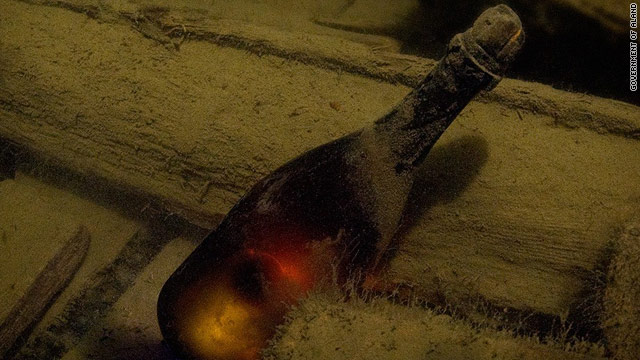
Last week, CCN.com reported that divers in Scandanavia have uncovered the oldest drinkable beer in the world, an unidentified shipment of brew that was reportedly on its way to Russia sometime between 1800 and 1830 when it went down with the ship. There it sat, at the bottom of the sea, until its recent recovery.

Researchers will be using the next few months to determine its exact composition and recipe, during which TCM is sure that they’ll sneak a taste when no one’s looking. But The Common Man will, sadly, never get to drink it. This may not be a terrible thing, mind you, as there’s no real sense of whether the beer has gone flat in 200 years. But the culture inside of it is still, apparently, active, and it has been stored at ideal temperatures (near freezing) and light levels (none) for its entire life. It may damn well be the best beer in the world, in addition to being the oldest. But we’ll never know.

Obviously, the oldest beer in the world reminds us that, despite the injuries that sidelined him for the back half of 2010, Jamie Moyer is still an active pitcher.

Monday, July 26, 2010

Beer Leaguers: Goose Island 312 and Omar Vizquel

There was no beer in The Common Man’s household on Friday, and so TCM politely asked his beloved Uncommon Wife to pick some up while she was at the store. He left her with the cheery instructions to “just get anything that looks interesting.” She returned with a six pack of Goose Island 312.

312 is a wheat ale that has garnered a lot of attention recently because it was the beer Barack Obama exchanged with British Prime Minister David Cameron following the US-England tie in the soccer World Cup. Hailing from the President’s adopted home in Chicago, 312 was an apt P.R. choice to give the Prime Minister.


Too bad the beer itself is undeserving of this kind of honor, much like Omar Vizquel is undeserving of a spot in the Hall of Fame.

Like 312, Vizquel calls Chicago home these days, as a utility infielder for the White Sox. Vizquel has had a long and storied career. He debuted with Ken Griffey Jr. in Seattle in 1989, two years before the Seattle franchise’s first winning record. Underappreciated in the Emerald City, Vizquel was dealt to the Indians for Felix Fermin in a challenge trade that Cleveland handily won. Vizquel would become a stalwart part of the Cleveland infield for 11 years, helping the club establish its mid-nineties dominance over the AL Central. He continued to play effectively up until 2008, when he really began to suffer the effects of his age.

Somewhere along the way Vizquel, like Goose Island 312, earned a reputation he didn’t deserve as the best or second best fielding shortstop of all time. 312’s brewers claim that it reflects the “active lifestyle in the city” and is “very accessible to a wide range of people,” such as “people who don’t generally drink craft beer. This would lead you to think that the beer is incredible, since it's so popular. But it falls into that same nebulous category as The Blind Side or CSI:, which appeal to a broad spectrum of people, without actually being that good. They are good enough, with broad appeal and enough of an edge to make viewers feel dangerous for watching them, without the ambition to make them great.

And despite what his supporters may tell you, Omar Vizquel has never been great (with the very brief exception of 1999). He has long simply been a mediocre hitter and a very good fielder, who has managed to rack up 11 Gold Gloves. However, as Keith Law pointed out today in his epic Twitter fight with Vizquel’s army of irrational supporters (following his ESPN.com article on Vizquel’s unworthiness for the Hall of Fame), the Gold Glove voters have recently chosen to honor Derek Jeter and Michael Young at the most important defensive position, undercutting the credibility of the award. And in a time when the nature of the shortstop position was in flux, as Vizquel-types generally gave way to Jeters, and Garciaparras, and Tejadas, and A-Rods, Vizquel was never nearly as valuable as some of his heavier hitting colleagues. As such, he made just two All Star teams.

Yet Omar’s supporters continue to want to claim that he was as good, or almost as good as Ozzie Smith with the glove. This is likely because they never saw Smith or because time makes perspective get all wonky. Or because of some enthusiasm and emotional attachment that causes them to overlook more rational analysis. According to FanGraphs, Vizquel is the 13th best defensive SS in MLB history, and his 48.4 Wins Above Replacement has him tied with luminaries like Del Pratt and Cupid Childs. Even for a Big Hall guy like The Common Man, that’s probably a bridge too far, particularly when WAR ranks him as the 32nd best SS of all time. He’s a good player, a championship caliber player, but he’s not an elite player, and he never was.

Likewise, while Goose Island 312 is a good beer, and a drinkable one, there is not a lot to recommend it for any kind of diplomatic gifting. It’s light and drinkable, but it’s a little dry on the back end and bitter up front, walking a fine line between good and unpleasant. It also has a low ABV (4.2%), which means that you get less kick for the inflated price. And there’s really nothing especially memorable about it. In the end, you’re left to wonder what all the fuss is about. It’s not a beer to honor, let alone immortalize. It will do its job and quench your thirst; and that should be good enough.

Tuesday, June 22, 2010

Beer Leaguers: Berghoff Sundown Dark and Denard Span

On Friday, The Common Man was walking through the booze section of his local supermarket, when he spied a cheap beer with a sharp looking label. At less than a dollar per bottle, The Common Man was pretty sure that he was about to get hosed, particularly as he had not heard anything exciting about this brew, but figured to try it anyway. And that, dear friends, is the moment that Berghoff Sundown Dark entered TCM’s life. The six pack is long gone now, the bottles tossed into the recycling bin. But the flavor and the crispness are still with The Common Man. The Sundown Dark comes on full and malty, with a sweet dark taste, perhaps with a hint of molasses. It is rich and satisfying, particularly out of the bottle, but not overpowering. The Common Man was genuinely surprised by how much he liked it. And he wants more.

Similarly, when the Twins promoted Denard Span in 2008, The Common Man wasn’t sure what to make of him. Span had been taken in the first round of the 2004 draft, and was projected to move as a Kenny Lofton-esque leadoff hitter. He did not project to hit for power, but looked like a baseball player at 6’, 200 lbs. After some high-OBP, low SLG success in the low minors, Span seemed to stall at AA in 2006. Despite struggling at New Britain, Span was promoted the next year to AAA Rochester, where his walk rate continued to suffer, and his strikeout rate ramped up. Plus, the Twins’ supposed leadoff man of the future had been caught 14 times in 39 attempts to steal. It was looking more and more like Denard Span was going to wash out.

When Michael Cuddyer suffered a hand injury, Span made his debut in rightfield. His performance was not encouraging. Through April 24, he was hitting .258/.324/.258 and the Twins were scuffling out of the gate. Span was sent down, where something clicked. He not only rediscovered his hitting stroke (batting .340 in 156 ABs), but found his batting eye (26 BB in 184 PAs) and power as well (.481 SLG). When Cuddyer went down again at the end of June, Span was recalled and continued his hot hitting. From June 30 on, Denard Span played in every single game and hit .297/.393/.449 and stole 15 bases in 22 attempts. On July 22, Span became the team’s leadoff hitter, and hasn’t given it up since.

When Span was called up, The Common Man didn’t know what to make of him. TCM remembers Aaron Gleeman’s frustration both with Span’s lack of development and at the decision to call him up and start him in rightfield, and TCM remember agreeing with him. Hell, Gleeman didn’t even include Span in his list of the Twins’ top 40 prospects before 2008. And indeed, Span looked lost when he first got to the major leagues. But in the two years since his coming out party, Span has been terrific, posting a strong batting average, a good walk rate, and adequate speed on the bases. This year, while his batting average has suffered, he has maintained his solid BB rate, sees just as many pitches per at bat, and has stolen 14 bags while only being caught once.

In addition, Denard Span plays baseball hard. It’s common for announcers and pundits to praise “hard-nosed” and “gritty” players like Nick Punto (who is, oh hey, white!), but they rarely mention Span, who worked hard to make himself into a productive hitter, hustles on the field and on the bases, and plays with a strong competitive instinct. While that kind of attitude may or may not help the team in a measurable way, it’s endearing to a fanbase that has come to appreciate their leadoff man.


Joe Mauer and Justin Morneau may be the golden boys in the Twin Cities these days. They certainly look good, and play well, and cost the team a pretty penny. But the modest, engaging, and inexpensive ($750,000 this year, 5 years/$16.5 million with a club option) young center fielder is quickly becoming a new favorite around town. He certainly surprised The Common Man, even more so than a certain dark brown ale that TCM is craving right now.

Tuesday, May 25, 2010

Beer Leaguers: Staggering Elk Lager and Pedro Feliz

This weekend, The Common Man and The Uncommon Wife were helping a friend, watching her tween son and daughter while she was out of town. The Boy loved having a temporary brother and sister, and we enjoyed their efforts to keep him busy. Upon coming back from the store with TUW, the kids brought The Common Man an assortment of beers to bolster the mind and spirit. Some were excellent (TCM’s looking at you, White Rascal Belgian-Style Wheat Ale...mmm). Some…not so much.

Staggering Elk Lager, from the Estes Park Brewery in Colorado, is one such disappointment. The Common Man doesn’t know much about Estes Park, except that it apparently is too busy brewing to actually put up a website of its offerings; instead, it offers this amateurish mea culpa. (Yeah, there’s so much to do, Estes Park. How about you hire a decent web writer for a couple thousand bucks to put up even the smallest reference to what beers you make, where to find them, and something about your restaurant? No? OK, you just continue to suck then.) Even the label is ugly and uninspired. The beer itself is incredibly underwhelming. There is almost no carbonation, leaving a very small head that quickly disappears after you pour it. The lack of carbonation severely affects the taste of the lager, making it flat and stale.

Flat and stale almost perfectly describes one of the Astros’ big free agent signings this offseason, Pedro Feliz. Feliz was inked to a one year, $4.5 million contract by GM Ed Wade to bump Geoff Blum off of 3B and into a utility role in 2010. Feliz has never been much of a hitter, (.252/.291/.418, 82 OPS+ for his career) and has been especially poor this year (.210/.235/.301, 42 OPS+). And his defense, admittedly his biggest asset, has been in decline since 2007 (according to UZR), and has collapsed so far this year (UZR suggests that Feliz has cost the Astros almost three and a half runs in the field). At 35 years old, Feliz shouldn’t have been seen as a solution to anybody’s problem. For a team that should have been rebuilding, like the Astros, Feliz’s presence only underscores how misguided the team’s priorities have been, filling its roster with known names, rather than productive players. Things are so bad in Houston that Feliz has batted 3rd 8 times this year, and 5th 7 times. And he’s playing so poorly that, even if the club decides to rebuild by trading away Roy Oswalt (who has requested a trade) and Lance Berkman (who is open to one), Feliz will have no value.

Meanwhile, Chris Johnson is 25 years old and is blowing away the Pacific Coast League in his third go-round in AAA, to the tune of .389/.433/.722 with 3 homers and 7 doubles in 60 plate appearances. Johnson may not wind up being a long term solution at 3B, as he has hit just .280/.321/.455 in 579 plate appearances overall for Round Rock, but he’s clearly learned everything he needs to in the minors and now needs an extended exposure to major league pitching to see what he has. At present, he’s only had 55 major league at bats, and has started three consecutive games just once in his career, before he strained his oblique and was put on the DL. Now healthy, he’s stuck in AAA until the Astros wise up.

That stale and flat taste in your mouth is the Pedro Feliz era in Houston. The team has the worst record in the National League and is already 10.5 games out of 1st. Forty-four games in, they’ve already been outscored by more than 70 runs, and have scored exactly 3 runs per game. Five members of their eight-man starting lineup have an OBP below .300 (in addition to Feliz: Quintero .250, Manzella .259, Lee .236, and Pence .268). The highest slugging percentage on the team (.462) belongs to a pitcher (Felipe Paulino). The highest among real players is Lance Berkman’s .437. The Astros are last in the National League in batting average, on base percentage, slugging percentage, hits (by 33), and walks (by 45, they are the only NL team under 100 walks). As a result of their free swinging ways, they have almost 100 fewer plate appearances than the next closest team. Hilariously, yesterday David Coleman of Crawfish Boxes actually listed the 10 Dumbest Yet Plausible Moves the Astros may yet make in 2010, so by no means is the horror show likely to abate.

And frankly, ugly and uninspired is another great way to describe these Astros. Like the label of Staggering Elk, no one should be forced to look at this team. Scuffy Moehler? Bud Norris? The since jettisoned Kaz Matsui? Carlos Lee? Houston has become the place where bad ballplayers go to die. Indeed, as Pedro Feliz flails his way across the diamond like a honest-to-god staggering elk, remember that the most humane thing may, ultimately, be to put it down so it doesn’t take resources from younger and stronger members of the herd.

Tuesday, May 18, 2010

Beer Leaguers: Capital Supper Club and Roy Halladay

The Common Man was doing chores yesterday evening, while taking in the Twins win over the awesomely-named Blue Jays. He was surprised when the usually efficient Kevin Slowey, despite walking none and striking out only two, had thrown 99 pitches through five innings, and was removed. As Bert Blyleven and Dick Bremer pointed out, Slowey has gone six innings or more just once in eight starts this year. This is new for Slowey. In his first 16 starts last year, before getting hurt, Slowey went six or more innings 10 times, while topping 100 pitches only on three occasions. Slowey is decidedly a product of this era, in which pitchers tend to be monitored closely for fatigue and removed before throwing too many bullets. Indeed, in four seasons, Slowey has never been allowed to throw 110 pitches.

All of this was relatively academic, of course, as the Twins won and there was much rejoicing. As the Twins recorded the final out, The Common Man took a deep pull off of his sharp Capital Supper Club beer, and was satisfied. Brewed in Madison, Wisconsin, Supper Club is a relatively new release for a celebrated local brewery that boasts on the bottle that it’s “not bad.” Capital’s website explains that their latest creation is, "Harking back to an era where Supper Clubs were In Vogue and Wisconsin had numerous regional breweries making their version of American Style Lagers. You know, back when these types of beers exhibited regional soul. And many of these beers were enjoyed during an evening spent at a local Supper Club, visiting with friends and family and having a good dinner. Supper Club is an eminently drinkable version of a true American Lager. Featuring a greater depth of refreshing malt character than the mass marketed versions of the style, Supper Club is clean yet satisfying. Classic Wisconsin Lager at it's[sic] finest."

And, indeed, it does harken back to an earlier era. An era of Schlitz, Blatz, Schmidt’s, Stroh’s, Hamm’s and Pabst. An era where regional delicacies were common, and men pledged allegiance to their local brewery almost as much as they did to the flag. It’s an era where Kevin Slowey would not be comfortable, because it’s an era where pitchers were expected to finish what they started.


Roy Halladay, however, would feel right at home. Halladay, of course, has led the league in complete games five times in his career, including once in a season where he started only 19 games (2005), and each of the last three years. He already has three complete games this year for the Phillies in eight starts, and is leading the league in innings pitched. He’s also got a 6-1 record and a 1.59 ERA, so he’s obviously taken a shine to the National League.

He has thrown 52 complete games in his career, which is just four more than rubber-armed Livan Hernandez, but 20 more than the #3 men on the list, Tim Wakefield and Jamie Moyer, who are 10 and 14 years Halladay’s senior, respectively. In fact, only 27 pitchers in baseball today have more than 10 complete games, none of whom is younger than 28 (Dontrelle Willis, who has 15). Only CC Sabathia, who has 30 CG through age 29, has a remote chance of catching up to Halladay, but would have to average more than five CG per year to match Doc’s pace. Halladay is an amazing specimen reminiscent of the bad old days when Juan Marichal completed 30 of 38 (1968).

Often, today, you hear these old days of supper clubs and complete games referred to with great fondness and nostalgia, leading you to believe that it was a better time. A simpler time. But The Common Man doesn’t necessarily think that’s true. Yes, it’s fun to see Halladay and Sabathia work deep into games, anachronisms on display every five days. But there’s a reason these players seem so out of time and place: most pitchers simply cannot handle that kind of strain.

In 1976, despite his team finishing 25 games out of first place, the Tigers let Mark Fidrych throw 25 complete games in 29 starts. Sandy Koufax threw 54 complete games and 658.2 innings in his last two seasons. Billy Martin made Mike Norris complete 36 games in 56 starts from 1980-81. This, essentially, shredded their arms and ended their careers. Koufax was done at 30, stricken with crippling arthritis in his left arm. Marichal became league-average after 1969, and was washed-up at age 35. Fergie Jenkens was a totally different pitcher after 1971, when he completed 30 games. Catfish Hunter signed with the Yankees, completed 30 games, and promptly nosedived. He was no longer an effective pitcher at the age of 30. Whitey Ford was used sparingly in the ‘50s, but had his workload ramped up once Casey Stengel was fired (he jumped by more than 90 innings from 1960 to 1961) and was basically done at 36.

Is that really what you want? Pitchers flaming out left and right? Do you really want a world of Fernando Valenzuelas and Orel Hershisers, whose effectiveness is stripped from them before they turn 25 or 30, respectively. Today’s pitchers may be babied, but the rate of catastrophic arm injuries seems to have fallen. Part of that, of course, is due to better medicine, but part of that is due to more manageable workloads, and a better sense of how valuable those right and left arms can be. Yes, an occasional Nolan Ryan or Gaylord Perry, Tom Seaver or Steve Carlton can bust through and be a workhorse for 15 years or more. But along the way, you’re going to ruin the arms of a lot of Ramon Martinezes, Dave Boswells, Dean Chances, and Kerry Woods. And The Common Man doesn’t think that’s worth the price. A variety of great pitchers is far more interesting than 3-4 top guns.

Likewise, do you really want a world full of 10,000 generic American Style Lagers, when some of the most fun and exciting beers today are coming out of micro-breweries, larger local breweries like Capital? Do you really want another Budweiser clone, when you can have an IPA, Chocolate Porter, Oatmeal Stout, or Maibock? The variety available today due to increased specialization and competition among the micros and greater shipping capacity totally blows away the drudgery of the supper club era. The American Style Lager is generally a great beer. Supper Club is light, but crisp, with a mellow and clean aftertaste that invites you back for more. It’s terrific. But you don’t want to be trapped in a world of Supper Clubs. It’s a nice treat when it comes around in the rotation. Just like Roy Halladay.

Tuesday, April 20, 2010

Beer Leaguers: Four Peaks Hefeweizen and Jonathan Papelbon

First, a programming note: The Common Man is on vacation this week in Scottsdale. From work, not from blogging. But that may mean that some of the blogging may be erratic, as he tries to schedule writing around family-type activities. Also, tonight TCM will be attending the Diamondbacks-Cardinals game at Chase Field in Phoenix. If you’re going to be there, drop TCM a line at the email address on the right and let’s grab a beer. Also, if you have suggestions of things to do or eat at the park, let TCM know.

Speaking of things you ingest, The Common Man and The Boy (The Uncommon Wife doesn’t join this vacation until Wednesday) were treated to dinner by The Boy’s grandmother last night at Oregano’s, a terrific pizza joint in Scottsdale (although there are 8 locations in Arizona. While it’s set up for adults, complete with an outdoor bar and patio, it’s a terrific place for kids as well, as The Boy got his own pizza dough to play with. The beer was also terrific.

Four Peaks Hefe-weizen is brewed locally, in Tempe and is terrific. It’s a springtime or summertime beer, which is perfect since it’s always spring or summer in Arizona. The flavor is smooth and light, but very flavorful, especially when accompanied by a lemon wedge. The citrus is a perfect complement to its maltiness. It presents as a cloudy yellow, as a result of being unfiltered. The yeast mellows the bitterness of the hops and makes this beer eminently drinkable. It’s not overly complicated, but it is a crowd-pleaser.


It’s a lot like Jonathan Papelbon, actually. As discerning baseball fans know, Jonathan Papelbon may actually be insane. He is loud and goofy, and prone to say ridiculous things. For instance, why does he wear his undershirt? “It’s a free shirt. You can’t beat it with a stick. I don’t have any reason behind wearing it. It’s just a free shirt.” What’s his entrance music? “'Let the bodies hit the floor,' something like that. I think the fans were more worried about my entrance song than I was. They can send in suggestions if they have some.” How’s married life? “I'm all good. I'm married now, man. All I've got is one person to answer to.” What’s his favorite board game? “Don’t make me bring the Scrabble board to the locker room. I will bring it." Why did he name his son Gunner Roberts? “Just a badass name, so we went with it.” What should be done about long game times? “Bundle up and drink beer . . . If you don't want to be there, don't be there. Go home. Why are you complaining." What does he think of Manny Ramirez? “For him not to be on the same page as the rest of the team was a killer, man! It just takes one guy to bring an entire team down, and that’s exactly what was happening. Once we saw that, we weren’t afraid to get rid of him. It’s like cancer. That’s what he was. Cancer. He had to go. It sucked, but that was the only scenario that was going to work.” How do you handle clubhouse disputes? “Even a guy like me, just heading into my fourth year in the big leagues — if David Ortiz gets a little, you know — I’ll tell him what’s up! I’m not afraid to do that. I’m not afraid to put him in his place, because I think everybody needs that. And if somebody does it to me, I understand that. I most certainly understand that. Varitek tells me all the time, 'Just shut up. Do what you’re supposed to do.'” Now why would Jason Varitek say that?

Plus, nobody dances a jig quite like Jonathan Papelbon:


But as unbalanced as Papelbon can seem, there is no doubt that he’s a fantastic pitcher. In his first four full seasons, Paps garnered 151 saves across 264 innings, with 312 strikeouts. He had a 5.20 K/BB ratio and just a .917 WHIP. He had a 1.74 ERA. He converted his save opportunities 90% of the time, and was asked to go more than three outs in 17% of his appearances. By contrast, Joe Natan had 159 saves and more innings and Ks, but a lower K/BB and went more than 3 outs in just 7% of his outings. He has a devastating fastball that averages 94-95 MPH. And despite an overreliance on his fastball last year, it was still one of the most 25 effective fastballs in baseball for anyone with more than 50 innings. Like the Hefeweizen, Papelbon may be unfiltered, but he’s crazy good.

Tuesday, March 30, 2010

Beer Leaguers: Gumballhead, Brian Bannister, and Pat Neshek

Last night, The Common Man finished his dinner, put The Boy to bed, and came downstairs to find The Evil Dog had peed on the kitchen floor, despite having been walked not one hour before. Here was a situation that clearly called for a beer.

And so, The Common Man popped the top off of a Gumballhead, a wheat beer made by Three Floyds Brew Pub, in Munster, Indiana. The psychedelic foil label features a yellow creature (Google tells TCM it's a cat who may or may not also be the star of his own web comic) of some sort smoking a cigarette and sporting what appears to be a black eye. Written up the side of the bottle are the words, "It's not normal."

Since the retirement of world-class crazy man Turk Wendell, The Common Man can only think of two ball players who really resonate with this slogan as baseball's true odd ducks. Brian Bannister, the starter for the Kansas City Royals, is the son of former Major League pitcher Floyd Bannister (who won 134 games from 1977-1992), which could lead one to believe that the younger Bannister is old school and conservative, status quo loving legacy. Banny is a fan of sabermatricians around the blogosphere; he is a strong believer in Defense Independent Pitching stats, and is thoughtful in how he dissects his own performance. He has a Bachelors in Fine Arts degree from USC, is a photography enthusiast and supports artists working in the Scottsdale area. Just his mere presence makes the Royals almost watchable in non-Greinke outings. Bannister always has something interesting to say, such that it's no wonder that Banny has made a disciple out of no less a writer than Joe Posnanski.

Likewise, Twins reliever Pat Neshek has made tremendous fans online for being one of the first active players to really blog about his experiences in the minor and major leagues. His insight and his enthusiasm are both greatly appreciated by his readers, as Neshek serves as a proxy for their broken dreams of never having a chance to make the big leagues. Indeed, while you and The Common Man may never have even played high school ball, we always felt we knew and respected the game far more than those who played it. Neshek's baseball card and autograph collections, his openess in talking about both, and his genuine awe at being a Major Leaguer, is refreshing for fans like The Common Man, who feel like they finally have one of their own to root for. Neshek's delivery, the jerky, whip-like, side arm action that fools righty and lefty batters alike also is a reminder of just how different Neshek is from your average major leaguer.

There is, however, one central difference between Brian Bannister and Pat Neshek. Neshek has thrown 120 innings at the big league level, and is coming off of a major injury (Tommy John Surgery). By no means is his full recovery assured, no matter how much The Common Man wishes it so. Still, in those 120 innings, The Freakshow has struck out 142 batters, and walked just 37 (in a row?). He is overpowering, and has an incredibly filthy slider. It's no exaggeration to say that, if he's healthy, Pat Neshek is absolutely nasty. Brian Bannister, on the other hand, The Common Man is sad to say is just not a good major league pitcher. After an exceptionally positive start to his career (14-10, 3.95, low HR/9 and BB/9 rates from 2006-2007, very low BABIP), the American League (or Lady Luck) seems to have caught up to him. In 2008, his HR/9 jumped (as did his K/BB ratio, however), and his BABIP also rose by 60 points (to .316). It held relatively steady in 2009. In the last two years, Banny has gone just 16-28 with a 5.29 ERA. It's clear that Bannister simply isn't a serviceable starter on a competitive franchise, and that he's not part of the long term solution for the Royals. Though he'll probably make a hell of a pitching coach some day.

And so, The Common Man is forced to make Brian Bannister the official Gumballhead of Major League Baseball. For one thing, he's got a lot of knowledge in that head of his, and some gumballs are awfully big. But more importantly, just like Bannister is not a good pitcher (no matter how much we want him to be), Gumballhead is not a good beer. Now, in the interest of fairness, TCM is generally not a wheat beer fan anyway, but this brew seems particularly egregious. It's exceedingly light, to the point where you can't really taste the beer. Rather, you get a splash of water across the bow, before a sharp hoppiness washes over the whole of your mouth. That's followed almost immediately by the most lemony aftertaste that The Common Man can remember having from a beer. And that aftertaste doesn't dissipate either. It sticks with you. It haunts you. It keeps coming back, and just gets more strident and insistent sip after sip, like Yankees in their second at bats against young Banny. Eventually, the aftertaste starts teeing off on your taste buds, and you run for a palette cleanser. And this might be The Common Man's imagination, but there might be the faintest smell of stale urine. Frankly, life's too short to drink this beer, unless you've got no other choice on hand. Fortunately for Bannister, the Royals don't.

Tuesday, March 16, 2010

Beer Leaguers: Red Menace Ale and Jay Bruce

You know what’s missing in baseball these days? Great nicknames. The 19th century through 1930s proved to be the strongest eras for nicknames in baseball history, with Old Hoss, King, The Crab, The Peerless Leader, Prince Hal, Bambino, The Iron Horse, Dizzy, and Schnozz being among the greatest titles bestowed upon stars, names that immediately recall an image of the player and how he was regarded. It’s long been lamented that writers and players today just don’t have what it takes to come up with original and descriptive monikers for their favorite (or least favorite) players. So this weekend, as The Common Man popped the cap off of a Hale’s Ale Red Menace Big Amber Ale, he knew that he had found the perfect nickname. After all, it’s practically a crime that no one has been hung with The Red Menace before now. But who to bestow it upon?

Of course, the recipient needs to be a Red. Cincinnati has had several players in its history that would qualify. Ted Kluszewski would have been an excellent choice back in the day, particularly given his imposing size and the era in which he played. Frank Robinson, with his all-around excellence also would have been a good choice. Pete Rose’s aggressive style might have earned it, if The Common Man didn’t hate him so much. Johnny Bench, Joe Morgan, and Tony Perez were all productive enough, if not actively menacing. George Foster, in the late 70s, would have been the guy. But let’s look to the beer for guidance.

Red Menace promises much more than it can deliver. In a short, fat, brown bottle, it appears stronger than its taller competitors. The imposing bust of Lenin on the front suggests the deadly seriousness of the former Soviet Union prior to the creation of Yakov Smirnoff. Hale’s website promises a taste that is “big…full flavored, and hoppy.” While the beer starts out strong, the hops flavor is actually pretty light, and the flavor peters out pretty quick. Really, there’s a lot of noise, but not a lot of signal in the beer, as it gives a strong first impression before becoming a wallflower. Alas, Red Menace does not live up to its name, becoming no more potent than Red Mild Annoyance, which is not as catchy a title.

Which is why The Common Man is forced to bestow this nickname on Jay Bruce. At 6’3” and 225 lbs, he definitely looks the part (especially if he’d grow a Lenin-goatee). Bruce came up in late May of 2008 and immediately made an impact. He went 3-for-3 in his debut, with a double, 2 RBI, 2 runs, 2 walks, and a stolen base. After his first seven games, he was hitting a ridiculous .577/.667/1.038 with three homers, 12 runs scored, and 7 RBI. But, of course, that was unsustainable. By the end of the year, Bruce had dropped to .254/.314/.453. Last year, Bruce struggled even more. He hit just .207/.283/.441 in the first half before righting his ship in the days after the All Star Game. Sadly, diving for a ball in the outfield, Bruce would break a bone in his right wrist and miss two months. It's safe to say that, thusfar, Bruce's most glorious and memorable moments on a major league field were his first few; and in this way, he is exactly like our beer in question.

However, there's good news for Red fans that, sadly, does not apply to Red Menace Ale. Jay Bruce is going to get better. Actually, he's going to get a lot better. Despite his struggles, Bruce was excellent for a 21 year old in 2008. And despite the precipitous drop in batting average, Bruce upped his HR% (4.7 to 5.7), BB% (7.3 to 9.8) and dropped his K% (24.3 to 19.4). As a result, Bruce dropped his K/BB ratio from 3.33 to just under 2.0. Even with his struggle to get on base, Bruce upped his OPS from .767 to .773. So why did he struggle so much in 2009? Bruce posted a freakishly low .221 BA on balls in play, 78 points below the league average. Among players with more than 300 plate appearances, Bruce's BAbip was dead last in the National League (and tied with Andruw Jones and Carlos Quentin for 2nd worst in MLB, behind Ken Griffey). Frankly, that's just not sustainable. The year before, Bruce hit .296 on balls in play, and his drop in singles and doubles artificially dipped his BA, OBP, and SLG to levels that don't accurately reflect his ability going forward. As a fun exercise, let's pretend that Bruce had just been marginally unlucky in 2009, and his BAbip had only dropped 30 points off its 2008 level, rather than 75, so that he hit roughly .266 on balls in play. To do that, we need to raise Bruce's non-HR hit count from 55 to 66 (putting Bruce's BAbip actually at .265). And if we do that, essentially giving Bruce 11 more times on base, his BA and OBP rise to a much more palateable .255 and .332 respectively. SLG, of course, would be harder to figure out, given that some of those hits would probably be doubles, but let's just give Bruce 11 singles. His SLG, already an impressive .470 would jump to .501.

Bruce still has significant platoon issues (848 OPS vs. RHP, ..597 vs. LHP) and is still young and developing. There's a chance that he'll never learn to hit lefties or that his development slows, and that he won't be the force that everyone predicted back in 2008, when he was the consensus #1 prospect in baseball. Tom Tango's Marcel system has him down for a .797 OPS. Baseballprojection.com has predicted an .890 OPS out of the young sluger. But if TCM were a betting Common Man, given the natural maturation process, additional exposure to NL pitchers, a fully recovered wrist, and even a moderate amount luck in 2010, TCM would say that Jay Bruce is poised for a huge season, somewhere in the mid-.950s, as he learns to control the strikezone even better and continues to drive the ball effectively. Jay Bruce, The Common Man dubs thee The Red Menace. Now go out and earn it.

Tuesday, February 23, 2010

Beer Leaguers: Sapporo and Hideki Matsui

Last weekend, The Common Man took The Boy to visit his grandparents and great-grandmother for a couple days, figuring he’d enjoy some home cooking. Of course, to The Common Man’s mother, “home cooking” usually involves either a) throwing a Costco-bought tri-tip roast on the grill or b) making reservations. On Saturday night, it was the latter, and the whole clan absconded to a new Japanese teppanyaki and sushi restaurant. The food was plentiful and delicious. The show put on by the chef was also impressive. The Boy especially loved seeing the fire and trying (unsuccessfully) to catch shrimp in his mouth (“I couldn’t catch it because I have a small mouth; when I get bigger my mouth will get bigger and I will catch it.”).

Along with his filet, scallops, and shrimp, The Common Man ordered a Sapporo. Sapporo is the most popular Japanese beer in the United States, and is considered an import, even though its North American bottles are just brewed in Canada. It's also still one of the more popular beers in Japan. The beer is clear and gold and has a clean and light taste that TCM would describe as brittle. What’s amazing to The Common Man is just how stereotypically “American” this beer seems. It’s like a slightly more flavorful Miller Lite, but its name and ancestry gives off the sense that it’s more special than it really is.

Essentially, this beer is Hideki Matsui. Now, The Common Man knows that it would be somewhat problematic to match up a Japanese beer with a Japanese player simply because they’re Japanese. Certainly, the common ancestry of both the Angels’ new designated hitter and this beer play a large role in this determination, but that’s not just because they are Japanese, per se. Rather, just as there are relatively few Japanese beers on the American market, there are very few Japanese ball players in the majors right now, particularly position players. So Taguchi got into 6 games last year for the Cubs, but he’s never gained any real popularity in the states, unlike Matsui. Similarly, Aki Iwamura and Kaz Matsui have never achieved mainstream popularity. Kosuke Fukudome is a huge source of frustration for Cubs fans. And Kenji Johjima has returned to Japan after a short, up-and-down career here.

Ichiro, of course, stars for the Mariners, but he has always been a singular force within the game, at once embodying excellence and otherness on the field. Forgive the expression, but everything about Ichiro informs the common acknowledgement of his Japanese-ness. His approach at the plate, the style of his game, his excellent defense, and his alleged aloofness and distance from his teammates. Indeed, Ichiro has always been held up as an enigma by the baseball press because of the communication barrier he uses and his disarming humor. Also, despite his enormous popularity both in the States and at home, he plays in Seattle, which is far outside the traditional scope of the mainstream media.

Hideki Matsui, meanwhile, has lived in a fishbowl as a member of the New York Yankees. His movements are constantly followed here and at home, sometimes to hilarious extremes. But unlike Ichiro, Matsui’s game is quintessentially American. Matsui is slow, hobbled by knee injuries that have limited him to the DH spot. He is patient, coaxing deep pitch counts from opposing hurlers; in fact, Matsui saw just shy of 4 pitches per plate appearance last year, rarely swung at balls outside of the strike zone, and coaxed 64 walks. And he hits for good power, sporting a .509 slugging percentage and 28 homers last year. His game has always been at clash with the stereotypical Japanese brand of baseball, which has emphasized defense, “fundamentals,” putting the ball in play, and one-run strategies.

Indeed, aside from the throng of Japanese reporters that follow Matsui wherever he goes, there is nothing really to discern him from Raul Ibanez, Pat Burrell, or Brad Hawpe, other defensively challenged outfielders who combine good power with decent on base skills. While there is no player like Ichiro, there are a dozen like Matsui scattered around Major League Baseball.

Like Sapporo, the only appeal that Matsui seems to have over these others is his marketability, stemming from his status as a prominent representative of another culture, living in our midst, and from his status in that home culture. But, like Sapporo, seemingly every other thing about him and his game is so damn pedestrian.

Tuesday, February 16, 2010

Beer Leaguers: Capital Maibock (seasonal)

It’s long been a cliché that baseball is a team game. If The Untouchables taught us anything, it’s that Sean Connery is a hilarious bad cop. But if it taught us two things, it’s that you “get nowhere unless the team wins.” (Also, Robert DeNiro’s dinner parties always break up early for some reason.)

And you can’t win a World Series with just one championship caliber player. Believe The Common Man, Barry Bonds gave it a shot. But Babe Ruth needed his Lou Gehrig. Mickey Mantle needed his Roger Maris. And Kirby Puckett needed his Kent Hrbek. What a championship team needs, aside from its superstars, are complementary players, guys whose effectiveness will throw the performance of these stars into sharper focus. After all, Babe Ruth could have hit 80 homers a year, but if no one is on base in front of him, the Yankees aren’t going to score a lot of runs. Earle Combs on base skills at the top of the New York lineup magnifies Ruth’s performance, making it so that even the commonest fan can appreciate the effort.

All of which is to say, The Common Man went out to dinner last night at The Boy’s request (he wanted a hamburger) and enjoyed his Capitol Maibock with dinner last night. While the real star of the meal was the prodigious steak sandwich with mushrooms, onions, and provolone, and the beer-battered mushrooms he got for an appetizer, the Maibock was a perfect compliment to the meal. While stronger beers (such as The Uncommon’s Wife’s Scotch Ale) might have proved too powerful or too bitter so as to overshadow the dinner, TCM’s choice was potent, without being obtrusive. It tasted like a beer should, mind you; there was no danger of mistaking it for the water. But its understated flavor, and lack of an aftertaste, made it a refreshing choice. While The Common Man wouldn’t choose this beer to be the foundation of an evening or plan a meal around it, he would absolutely order it again with dinner.

Last year, when the Yankees won the World Series, they did so on the backs of their superstars: A-Rod, Teixeira, Jeter, Sabathia, etc. But setting the table for these players, allowing them to excel even further, was Johnny Damon.
Damon’s played at least 140 games per season since 1996, has had an OBP north of .345 every year since 2002, has scored at least 90 runs every year since 1998. Despite the relative hype he’s received over his career, Damon has never been an elite player. His high OPS+ was last season, at 126. He has had one season with a WAR over 5.0. He’s been a good, solid contributor to every team he’s been on, but he’s never been their best player. But Damon’s effective work at the top of the lineup, and solid defense, first in CF, now in LF, has propelled his team, making the production of his team’s heavy hitters all the more impressive.

By virtue of playing in Boston and New York, Damon’s garnered far more notoriety than a normal complementary player might, and certainly his struggles to find a job this offseason have certainly thrust him into the limelight. But if Johnny Damon was named Rajai Davis or Ryan Sweeney or Denard Span, he would be quietly and unobtrusively facilitating your offense, and playing good defense. Making those around him better (he would also cost a lot less, meaning he would have little trouble finding a team). And helping the team to win games, and enjoy their seasons, on the sly. Only afterward, when the champagne has finished flowing and the hardware has been handed out, will you look back and appreciate their effect on the team. As it should be for the Capital Maibock of baseball, the cog you never appreciate until you lose it.

Tuesday, February 9, 2010

Beer Leaguers: Natty Lite and Willie Bloomquist

Once upon a time, as astute reader and friend of the blog BikeMonkey has pointed out, The Common Man used to write about a lot of stuff man-related. Beer, politics, sports, film, TV. That has largely gone by the wayside in deference to the almighty baseball; but that doesn’t mean it’s not fun to bring them back every now and again, particularly when TCM loves mix genres. So today marks the beginning of a new feature here The Common Man.com: Beer Leaguers. What follows is the first in a series that will compare baseball players to beer, or beer to baseball players, depending on your perspective. It’s an opportunity to combine TCM’s favorite topics, and to praise (or deride) the deserving. Today, in light of some nasty weather, The Boy peeing (again) in The Common Man’s bed last night, and two-hour meetings that start at 8:00, The Common Man is in a nasty temper. So today, he’s afraid, you get the dregs.

The beer/The ball-player


Fig. 1: Natural Light (aka Natty Lite, The Natty, Swill) and Willie Bloomquist

Natty Lite is about the most piss poor excuse for beer The Common Man has ever had. In the can, sure, it looks like it might do the trick, but dig deeper and you’ll see the beer looks like diffused urine and tastes not much better. The Common Man could barely stomach it in college, before he knew what beer was supposed to taste like. Now, of course, discerning beer drinkers know to stay away. Yet, across college campuses, Natty Lite is plentiful. It flows like the Amazon in the rainy season, a torrent of frothy yellow filth that no one should be forced to take internally, lest they contract a horrible parasite. Of course, the reason for its popularity is clear, Natty Lite is the cheapest beer out there, and college students don’t know better. While they could be getting plastered on better tasting/higher ABV beers, they throw their pennies away weekend after weekend, sacrificing quality for quantity.

Like Natty Lite barely qualifies as beer, Willie Bloomquist barely qualifies as a baseball player. He may look the part, filling out his uniform and generally looking athletic, and he’s definitely got speed, but in watching him every day you will be frustrated by his general lack of skills. He lacks power, plate discipline, and the ability to hit for average (last year, Bloomquist had a line-drive rate of 20%, and still only hit .265). He has played all around the diamond, giving the appearance that he’s a jack of all trades, but really has been below average at every position except 2B. And he’s horribly miscast when his teams try to use him in the OF or at SS. He’s the kind of player that makes you regret trying to play him. In 1829 PAs across 7+ seasons, Bloomquist has accumulated a WAR of 1.9, his highest being a 1.2 win season in his rookie campaign (which was immediately wiped out by a -1.2 win season the next year.

Like Natty Lite, Bloomquist became popular and prevalent for terrible reasons. First, he came up with the Mariners and was a hometown prospect, growing up in a suburb of Seattle. He was never really supposed to be a good player, either. Bloomquist had a .294 OBP as a 23 year old at AA (in the offense-happy Texas League!) and put together just a .714 OPS in AAA the next year. Still, as the M’s entered a five-year drought that saw them below .500 four times, lose 90 games three, and 101 once. Bloomquist became one of the few marketable and popular players on the team, and seemed approachable (unlike Ichiro, who got hung with an “aloof” label). He was a local boy who made good, even if he wasn’t particularly good. And he was “scrappy” and “made the most of his talent” unlike perpetual whipping boys Yuniesky Betancourt, Jose Lopez, Jeremy Reed, Richie Sexson, and Adrian Beltre. The fact that Bloomquist wasn’t very good simply didn’t matter much, and he developed an Ecksteinian reputation as a “gamer.”


Fig. 2 Gritty.

It’s not that Bloomquist is a bad resource to have around. Actually having a utility player who can handle, passably, six positions, and who you can give 100-150 PAs to is not a bad idea. It provides a team with flexibility and allows it to give its stars needed days off over the course of the season. Indeed, even Natty Lite fulfills a function, getting college kids to pull off ill-conceived stunts that end up on StupidVideos.com and have drunken hook-ups with their roommate’s ex-girlfriend’s roommate (which can lead to some fun and delicious awkwardness). But the reason Natty continues to fill this function and fill it well is because it is so cheap. Alas, as Bloomquist aged, he lost that cheapness that made him a good alternative. If Natty inexplicably raised its prices to $25 a case, the students would move on to another comparable brand (Keystone?). Like cheap beers, there are Bloomquist-esque utility-infielders-in-waiting all over the minor leagues, ready to be plucked from obscurity and given a chance to live the big league life for at or near the league minimum.

Which is why it is so strange that the Kansas City Royals, last year, just had to have Willie Bloomquist. They not only guaranteed him two years, but gave him $3.1 million for the privilege. It was like walking into a liquor store, finding Natty Lite for $14/case, and haggling with the clerk to give him an extra $5 for the trouble. Indeed, Bloomquist was probably overpaid by the M’s during his final season (he made $1 million), but at least he had some PR value. All he adds to the Royals is Tony Phillips’ versatility without the quality that made Tony Phillips so ridiculously valuable.

The year after they let Bloomquist walk, the Mariners used Ronny Cedeno and Josh Wilson as their backup infielders for the grand total of somewhere around $600,000, and even managed to make Cedeno part of the deal for new SS Jack Wilson. The M’s improved by 24 games last season (not because they got rid of Bloomquist, mind you, but their decision not to pursue him was indicative of a smart organization that knows how to find free or virtually free resources, and where to devote their energy and money). The Royals, on the other hand, snapped up Bloomquist. While agent Scott Boras has done client Johnny Damon a disservice this offseason, surely most of that negativity is balanced out by the ridiculous deal he got for Bloomquist. Not surprisingly, given their apparent lust for crappy middle-infielders,


Fig. 3 Exhibit B.

the Royals not only overpaid for Bloomquist, but gave him almost 40% more playing time than he’d ever had before. Indeed, Bloomquist got into 125 games in 2009, garnering 468 PAs. No wonder the lost 97 games. Nobody in their right mind would drink Natty Lite if they didn’t have to.


Fig. 4 Nobody in their right mind.

Saturday, October 4, 2008

Saturday Beer Review: New Glarus Spotted Cow

For the first time in as long as he can remember, The Uncommon Wife advocated for a "pajama day" for the Uncommon family. She, The Common Man, and The Boy were to remain in their jammies all day, and simply enjoy being at home together on a crisp fall day. Fortunately, The Common Man had beer available for his sequestering. And since The Common Man isn't leaving the house today, he has chosen a beer that is both close to his home and close to his heart.

And in choosing a beer to siphon, The Common Man would be foolish not go with New Glarus's Spotted Cow. The Cow is a light "farmhouse" ale, cloudy in appearance and complex in flavor. The bitterness of the hops is mellowed by a slight fruity flavor and a bit of sweet corn. The result is a delightfully flavorful beer that leaves no aftertaste and is very refreshing.

Indeed, if The Common Man weren't duty bound to remain indoors all day, he'd say it's the perfect beer to take on a family picnic. The fruity flavor compliments the outdoors, while the low alcohol content (4.8 ABV) means you won't be acting drunk in front of your kids. Never underestimate the importance of saving face.

When you're sitting around, watching the Brewers beat the Phillies, there is no better beer. You support the local art of brewmaking, the local team, and display local pride. And if you're not a fan of the heavier beers, The Common Man believes you can drink this and not feel ashamed or less of a man. Saving face is important in front of the boys too.

Sunday, September 7, 2008

Saturday Beer Review: Moose Drool Brown Ale

He knows, you've all been waiting with baited breath to see if The Common Man will show today. Well, here he is, boys and girls, in all his glory. Behold and admire him. He's sequestered in his mancave, watching the manliest of sports, pro football, and enjoying many a fine carbonated malt beverage. The world is a strange place: Brett Favre is wearing a different shade of green (since he's a Jet), former LaDanian Tomlinson caddy Michael Turner has 196 yards on the ground for the Falcons (in related news, once again the Lions suck), and the lowly Kanses City Chiefs are keeping it close in New England.

And since this is a topsy-turvy, bizzarro world, The Common Man felt it was appropriate to crack open a Moose Drool Brown Ale in honor of the GOP's vice-presidential nominee, Gov. Sarah Palin.
Palin, of course, has burst onto the political scene in the last week and a half. She has transformed public consciousness, making phrases like "hockey moms," "moose hunting," and "Alaska" part of the national discussion. Indeed, Palin's ability to rally her base and to label herself at once a loving mother (and soon-to-be grandma) and a pitbull has been particularly impressive.

Like Sarah Palin, Moose Drool comes from the northwest part of the country. Brewed in Missoula, Montana by Big Sky Brewing Co., Moose Drool understand the world from which Palin comes, with its harsh winters, its imposing terrain, and its "hockey." Of course, Moose Drool's origins lie further south and east than Palin has tended to roam, but still comes across as a manly, big brew for men who need a lot of flavor in their beer. Indeed, Moose Drool is nothing like the Yard Beer that Kevin, at Return to Manliness, wrote about a month back.

Anyway, like Palin herself, Mosse Drool presents several contrasts. It's name would imply that it's disgusting, yet the label, a serene painting of a moose swimming in a mountain pond, suggests a cleaner, fresher beer than you're used to. And, like Palin herself, it combines that sweetness with a killer hoppiness that is very bitter. It's the first beer The Common Man has profiled here that's almost better warm, or at least cool. The chill tends to accentuate the beers hoppiness while killing some of the chocolate and carmel flavors that sweetens the aftertaste.

This is a sipping beer, best to have before a good meal, as it will dominate the food you're trying to enjoy. And it's a good beer to drink with a sole friend at dusk. The Common Man, for instance, was introduced to Moose Drool by his good friend, Alto, who is essentially like Arnold Schwarzenegger to The Common Man's Danny DeVito. As they sat at The Common Man's cabin, on the deck overlooking the lake, thinking about the work they had done and the times they had seen together, they both knew that life was good. And that the beer was too.

So, in honor of Sarah Palin, go get yourself a sixer of Moose Drool and enjoy the rest of your weekend. You've worked hard to get to where you are. Or, maybe you're a cynical appeal to two demographics who you think you need to energize in order to win an election. Either way, you deserve it.

Also in honor of Governor Palin, The Common Man presents another installment of Stupid Man Tricks:


That seems to be a poor strategy for hunting moose, being 10 feet away and shooting one in the neck. Also, The Common Man loves how his buddy tries to call the moose back after it a) has just been shot and b) almost killed his companion. That is the definition of friendship, right there, trying to get your pal trampled a second time.